


Why in the news?
The United States of America conducted strikes codenamed 'Operation Absolute Resolve', in and around Venezuelan Capital Caracas leading to capture of the Venezuelan President.
Key Developments post the strikes
- United Nations: UN Secretary-General expressed deep alarm, stating that the strikes failed to respect the rules governing the use of force and stressed the need for "full respect" of the UN Charter.
- Strikes have highlighted issues such as violations of international law, violation of national sovereignty, unilateral armed aggression, and US imperialism.
- UN human rights office: Rejected the U.S. justification that the raid was necessary to combat human rights abuses, insisting that accountability cannot be achieved through military interventions.
- Response from various nations:
- In Criticism of attack: Nations including Russia and China as well as Colombia, Brazil, Mexico, Chile, Panama, and Cuba from Latin America expressed deep concern and criticized the action.
- In support of attack: Argentina, Paraguay and Israel praised the U.S. operation as a decisive step against narcotics trafficking and terrorism.
- European nations: They positioned themselves delicately to avoid strong condemnation while upholding international norms.
- India: It expressed deep concern and reaffirmed commitment to sovereignty and non-intervention, and called for peaceful, diplomatic dialogue.
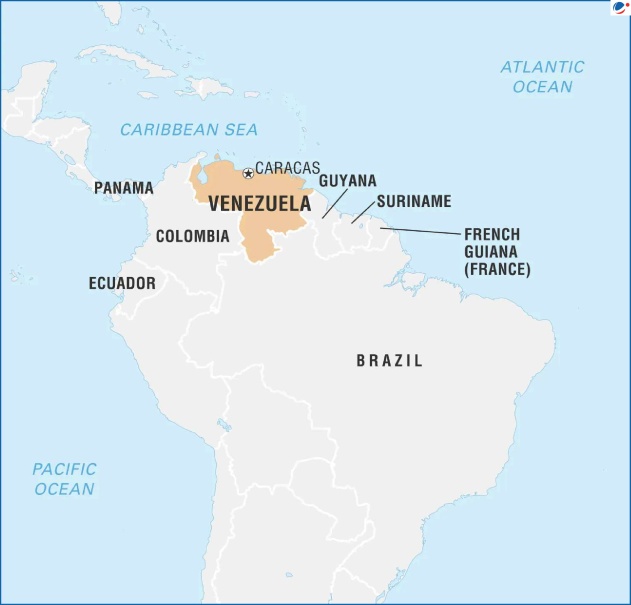
Probable reasons for the Strikes on Venezuela
- Official U.S. Justifications: Combating drug trafficking, narco-terrorism, mass immigration crisis and to combat transnational organized crime that threatened U.S. and regional security which is supported by Venezuelan regime as per USA.
- Political Illegitimacy: The U.S. argued that Maduro was not the legitimate head of state following the disputed 2024 elections.
- Control of Oil Reserves: Venezuela has vast crude oil reserves- 17% of global crude (largest in the world), mostly in the Orinoco Belt.
- Hemispheric Hegemony: The operation is widely viewed as the resurrection of the Monroe Doctrine now dubbed the "Donroe Doctrine" based on National Security Strategy 2025 of USA aimed at forcibly re-establishing absolute U.S. hegemony in the Americas.
- Severing Chinese and Russian Influence: The strikes are seen as a calculated move to purge extra-regional rivals, namely China, Russia, and Iran, from America's "near abroad".
- U.S. aims to sever Latin America's growing ties with China, redirect Venezuelan crude exports toward the U.S. market, and choke off a vital energy supply line to China.
- Spread of Socialism: United Socialist Party of Venezuela is in power largely in last two decades in Venezuela which is not aligned with US capitalist policies.
About Monroe doctrine
About "Donroe Doctrine," named after President Donald Trump
|
The strike attack on Venezuela along with recent developments like U.S.A.'s intention to occupy Greenland; renewed blockade threatening fuel shortages in Cuba; trade wars etc. has raised concerns regarding U.S.A.'s imperialistic tendencies and threat to "rules-based international order".
Potential consequences of US Imperialism
- Violations of International Law and Norms: The "apprehension and forced exile" of Venezuelan President is condemned as a "flagrant violation of international law" and a direct contravention of Article 2 of the UN Charter.
- Article 2 of UN charter legally mandated states to refrain from use of force with some exception such as self-defence.
- Destabilization: E.g., the 2003 invasion of Iraq resulted in the destabilization of West Asia and the rise of groups like ISIS.
- Weakened multilateralism: The U.S. has circumvented the UN Security Council, weakening multilateralism under institutions like the United Nations.
- Warning to International community: Failure of the post-Cold War hope for a "stable liberal order" is underscored by the actions of both the US and Russia (e.g., the ongoing conflict in Ukraine).
- Economic Fragmentation: Trade wars, economic sanctions, and export controls disrupt global supply chains through "Friend-shoring" and "de-risking" weaken globalization.
- Erosion of Sovereignty: Military interventions and sanctions may undermine national sovereignty.
- E.g., US President's threat to Greenland of military action to annex it fracturing the Transatlantic Alliance and asking Canada to become 51st state of USA.
Way forward
- United Nations reforms: Reforming the United Nations Security Council to reflect contemporary realities by including India, Japan, Germany, Brazil (G4) and greater African representation to reduce dominance of permanent UNSC members (P-5).
- Gujral Doctrine as a Model for Regional Stability: Though originally for India and its neighbors, it can be helpful for global peace through its principles like- Non-interference in internal affairs, Respect for sovereignty and territorial integrity, Peaceful resolution of disputes etc.
- New World Order: On the principles of Multipolar & Inclusive Framework transitioning from unipolar dominance to multi-polarity involving the U.S., China, EU, India, and emerging and middle powers.
- Strategic Autonomy & Multi-Alignment: India should pursue diversified partnerships rather than bloc politics avoiding overdependence on any one power for defence, technology, or energy as recently India concluded free trade agreements with UK, EU, and UAE etc.
- Promoting resilient supply chains: Need of "Re-Globalization" to address issues ranging from security, poverty to environment and global cooperation. (World Trade Report, 2023).
Conclusion
While U.S. imperial tendencies, including actions in Venezuela, raise concerns, they can catalyze stronger multilateral resistance, institutional reforms enforcing international law, empowering regional organizations, and accelerating movement toward a more balanced, multipolar, and rules-based world order.


