


Why in the News?
National Startup Day on January 16, 2026 marked a decade of the Startup India Initiative.
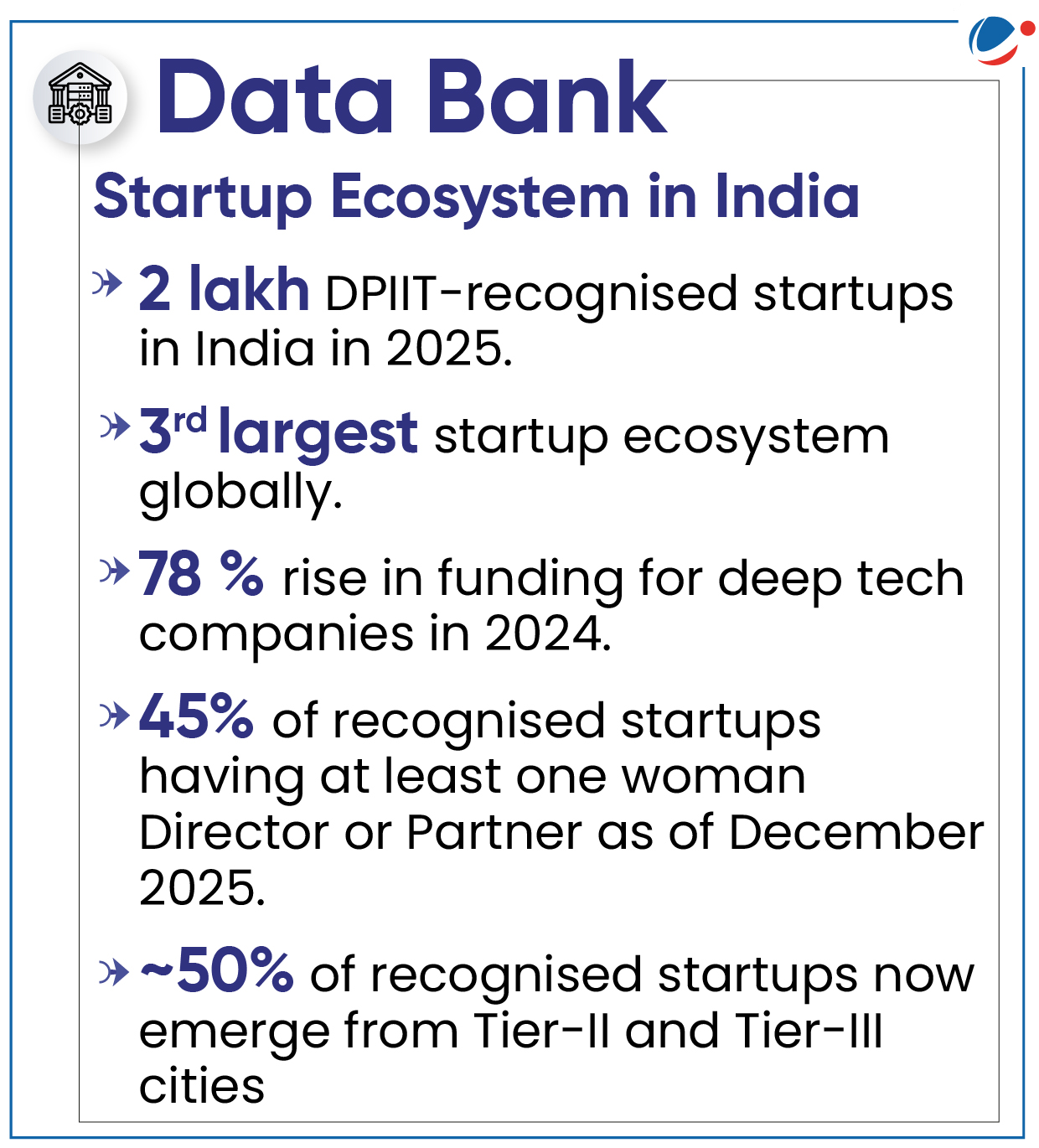
More on the News
- Startup India initiative was launched on January 16, 2016.
- January 16 was declared as the National Startup Day in 2022.
Definition of a Startup
- Legal Structure: It is incorporated or registered in India as a Private Limited Company, a Partnership Firm, a Limited Liability Partnership (LLP), or a Cooperative Society (including Multi-State Cooperative Societies).
- Age: It has been in existence for up to 10 years from the date of its incorporation or registration.
- Turnover: Its turnover for any financial year since incorporation has not exceeded 200 crore rupees.
- Scope of Work: It is working towards the innovation, development, or improvement of products, processes, or services, or it has a scalable business model with a high potential for employment generation or wealth creation.
Note: An entity formed by splitting up or reconstructing an existing business is not considered a Startup.
Key Components of the Startup India Initiative
- Financial Support Schemes:
- Fund of Funds for Startups (FFS): Managed by SIDBI with a corpus of ₹10,000 crore, this scheme supports SEBI-registered Alternative Investment Funds (AIFs), which in turn invest in startups to expand domestic risk capital.
- Startup India Seed Fund Scheme (SISFS): With a corpus of ₹945 crore, this scheme provides financial assistance for early-stage activities like proof of concept, prototyping, and market entry.
- Credit Guarantee Scheme for Startups (CGSS): Operationalized by the National Credit Guarantee Trustee Company, this enables collateral-free loans for startups.
- Digital Platforms and Ecosystem Enablers:
- Startup India Hub: A digital platform connecting stakeholders such as investors, mentors, incubators, and aspiring entrepreneurs.
- National Mentorship Portal (MAARG): A program designed to offer startups easy access to strategic guidance from experienced mentors.
- Startup India Investor Connect Portal: Facilitates connections between early-stage ventures and multiple venture capital funds through a single application.
- States' Startup Ranking Framework (SRF): Promotes competitive federalism by assessing States and Union Territories on their startup-friendly policies and implementation.
- Broader Ecosystem Support:
- Atal Innovation Mission (AIM): Focuses on creating an innovation culture through Atal Tinkering Labs (ATLs) in schools and incubation support.
- National Initiative for Developing and Harnessing Innovations (NIDHI), Department of Science and Technology: An umbrella program nurturing knowledge-based innovations into startups through components like PRAYAS (prototyping support) and Technology Business Incubators (TBIs).
- MeitY Initiatives: Includes the MeitY Startup Hub (MSH) and the Technology Incubation and Development of Entrepreneurs (TIDE) 2.0 Scheme, which supports ICT startups using emerging technologies like IoT and AI.
Role of Startups in Economic Development
- Employment Generation: Startups leverage India's demographic dividend to create jobs in tech, manufacturing, and services, while also generating indirect opportunities in gig work and supply chains. The NIDHI program alone has generated 1,30,000+ jobs.
- Bridging Rural-Urban Divides: Innovations in agri-tech, telemedicine, and microfinance are addressing developmental gaps. For example, agri-tech platforms improve market access for farmers, while rural schemes support sustainable livelihoods.
- Technological Integration: Startups are driving the adoption of deep-tech and emerging technologies, collaborating with large corporates for technology transfer and global market integration.
- Economic Multiplier: Ventures in clean mobility and digital infrastructure are producing multiplier effects across finance and sustainability sectors, positioning the ecosystem as a central driver for India's goal of becoming a $7.3 trillion economy by 2030.
Key Concerns with India's Startup Ecosystem
- Risk-averse Mind-set
- Low Tolerance for Failure: Indian society traditionally associates failure with stigma rather than learning.
- Preference for Stable Employment: Families and social structures prioritise secure government or corporate jobs.
- Financial Hurdles
- Funding Gaps: Early-stage startups struggle to raise capital as investors prefer mature ventures with proven traction.
- Cash Flow Management: Many startups fail due to poor revenue generation and high "burn rates" (spending money too fast).
- Regulatory and Bureaucratic Roadblocks
- Exit Barriers: Closing a business is often more bureaucratic and difficult than starting one.
- Taxation Issues: Startups struggle with tax compliance, including the controversial "Angel Tax" and delayed payments affecting liquidity.
- Talent and Mentorship
- Skills Gap: There is a disconnect between academic training and the practical skills required by the industry.
- Retention Issues: Startups struggle to retain talent against large corporations that offer higher job stability.
- Market and Infrastructure Barriers
- Price Sensitivity: Indian customers are highly value-conscious and often unwilling to pay for new services.
- Fragmented Market: India's linguistic and cultural diversity makes it difficult to scale a product across different regions.
- Lack of Industry-Academia Convergence: A mismatch between academic output and industry requirements.
Conclusion
As India enters the second decade of the Startup India Initiative, the focus must shift from scale to sustainability, from rapid proliferation to resilient innovation. Strengthening deep-tech research, easing regulatory bottlenecks, deepening industry–academia linkages, and nurturing entrepreneurial mindsets across geographies will be crucial to building globally competitive enterprises.
With coherent policy support, vibrant private participation, and an enabling socio-cultural ecosystem, India's startup movement can emerge as a cornerstone of inclusive growth, technological leadership, and long-term economic transformation.
Related News: Deep Tech StartupGovernment has removed condition of 3-year existence for deep-tech startups to qualify for recognition and avail financial aid under Department of Scientific and Industrial Research (DSIR)'s Industrial R&D Promotion Program (IRDPP). What is a Deep Tech Startup?In addition to the standard Startup criteria, a Deep Tech Startup must demonstrate the following attributes:
Other initiatives taken for DeepTech Startup in india
|


