


Why in the News?
Department of Economic Affairs (DEA), Ministry of Finance, created a three-year PPP project pipeline to streamline infrastructure development in the country.
More on the News
- This followed ₹12.2 lakh crore public capex (Capital Expenditure) announced in Union Budget 2026-27.
- Public capex increased from ₹2 lakh crore in FY2014-15 to ₹11.2 lakh crore in BE 2025-26.
- The pipeline offers an organised framework, early visibility of potential PPP projects enabling investors, developer and others to undertake informed planning and investment decisions.
- PPP project pipeline comprises 852 projects across Central Infrastructure Ministries and States/Union Territories with a combined total project cost of over Rs. 17 lakh crore.
About PPP
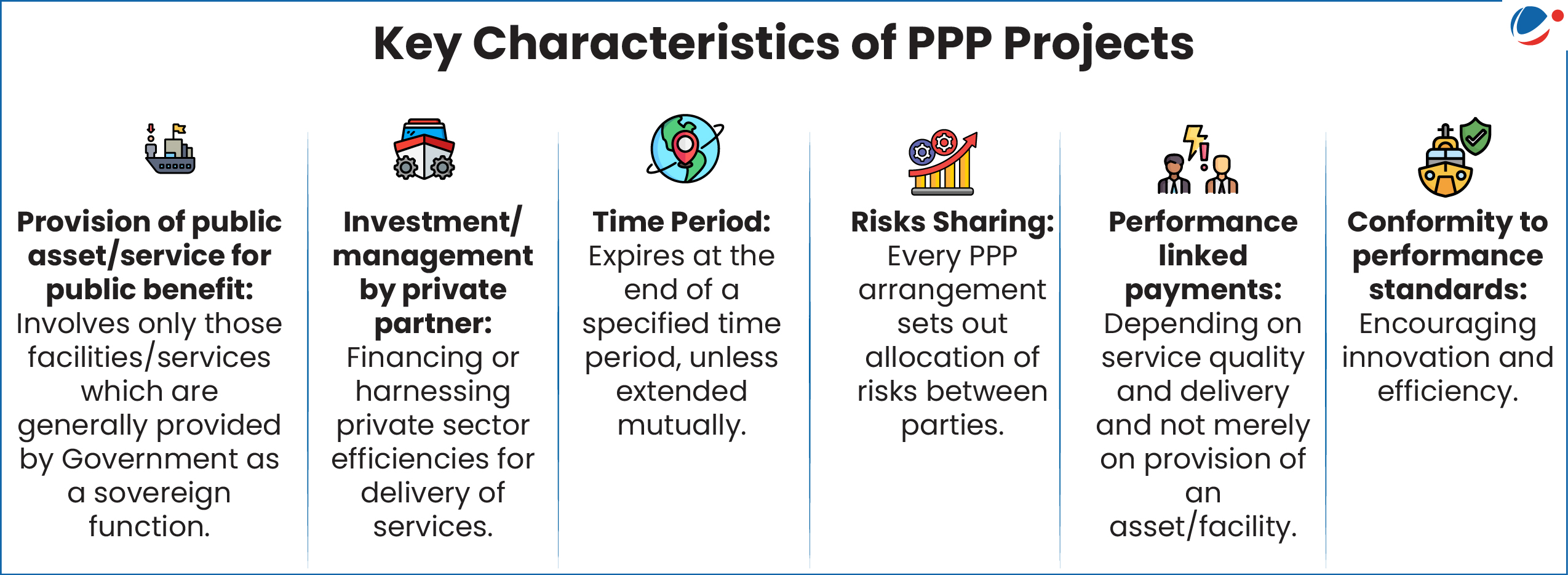
- Meaning: Arrangement between a Government and a private sector entity for provision of public assets or services in a contract outlining each party's responsibilities.
- Trends in India: As per World Bank's Private Participation in Infrastructure (PPI) Report 2024, India has consistently ranked among top five countries globally in terms of private investment in infrastructure among low- and middle-income economies.
- India emerged as largest recipient of PPI investment in South Asia, accounting for over 90% of the region's total private infrastructure investment.
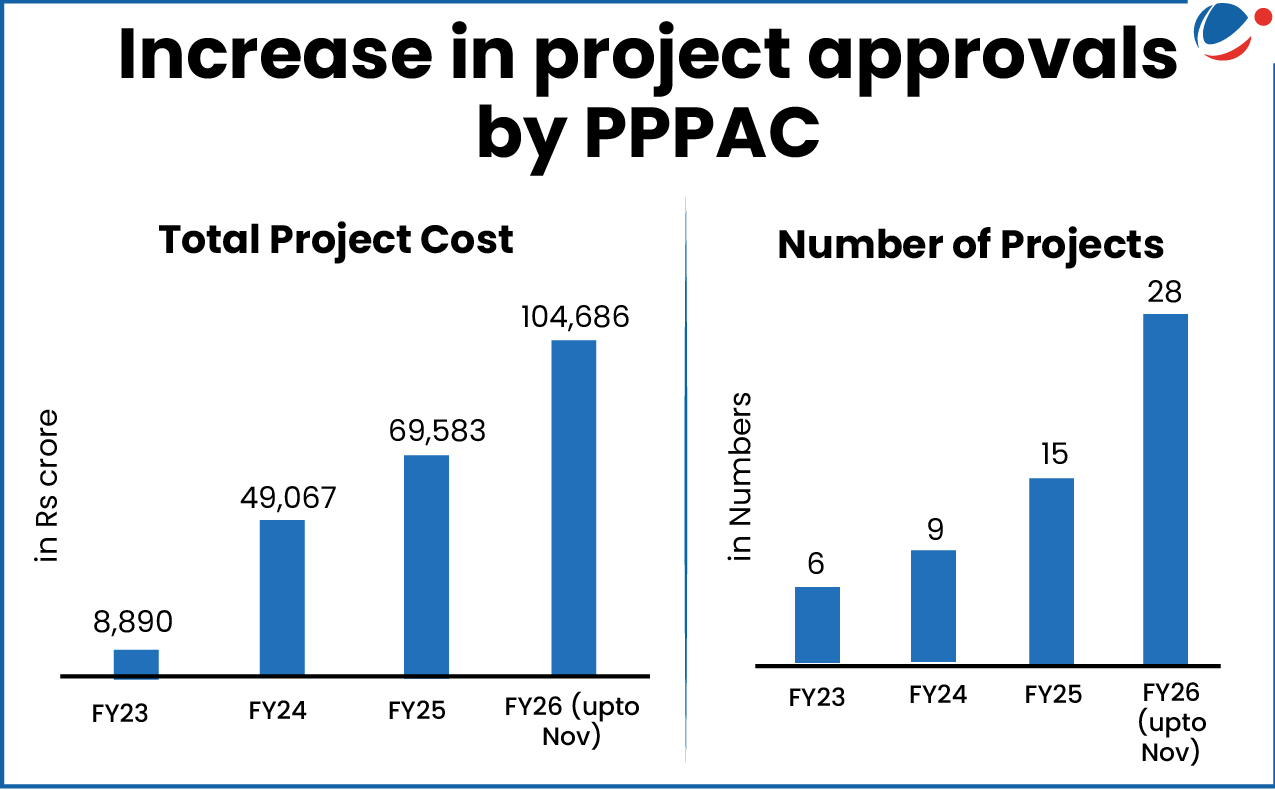
- 129 projects with Total Project Cost (TPC) of ₹5.6 lakh crore have been recommended by Public Private Partnership Appraisal Committee (PPPAC) [From 2014-15 to 2025-26 (up to 04 December 2025)].
Key Investment Models under PPP | |
Build, Operate and Transfer (BOT) | Private partner to design, build, operate (during contracted period) and transfer back facility to public sector. E.g., National Highway projects. |
Lease, Operate and Transfer (LOT) | Already existing facility entrusted to private sector (based on mutually decided terms) and transferred back to government once contract ends. |
Build, Own, Operate or Transfer (BOOT) | Facility is transferred to government after end of contract period post private partner recovers its investment. |
EPC (Engineering, Procurement and Construction) | Government provides its requirements and contractor prepares detailed engineering design, procures all materials/equipment and then constructs to deliver a functioning facility to government. |
Hybrid Annuity Model (HAM) | Combines EPC (40%) and BOT-Annuity (60%). Government releases 40% of total project cost while balance is arranged by the developer. |
Importance of PPP Model in Infrastructure Development
- Private Sector Efficiency: The private sector is exposed to competitive pressures providing an edge in carrying out capital (design, construction) and operating phases of project.
- Private sector is well placed to access quality, skilled manpower and technology and hold its employees, suppliers and vendors more accountable to performance.
- Focus on Life Cycle Costs of Projects: In addition to designing and building project, private partner also provide ongoing operations and maintenance (O&M) with an incentive to ensure that design and construction facilitate efficient O&M.
- Increased Transparency & Accountability: In contrast to conventional procurement where public entity is both monitoring and providing service and may be reluctant to question itself.
- Access to Private Sector Finance: PPPs allow public entity to leverage private finances in development of public infrastructure leaving more bandwidth to invest in social and other sectors without the need for borrowing.
- Promoting Ease of Doing Business: India aims to reduce logistics costs to below 10% through PPP reforms.
- Currently developed countries operate with logistics costs of around 8-9%.
PPP in Key Sectors of India
|
Key Challenges faced by PPP
- Contract uncertainties: PPPs often cover a long-term period (e.g. 15-30 years, or asset life), wherein huge costs could be involved in modifying contract as per future requirements.
- Aggressive Bidding: The private sector often engages in over-aggressive bidding with inadequate due diligence, leading to unviable offers and subsequent project failures.
- Regulatory Environment: Changing Governments and legislations has negative impact on PPP projects including issues in attracting further domestic and international funding.
- Demand and Forecasting Uncertainties: Inaccurate demand forecasting (such as overestimating traffic on a toll road) can drastically affect the private partner's revenue, making it difficult to demonstrate Value for Money (VFM) in advance.
Key initiatives to strengthen PPP in India
|
Way forward on Reforming PPP
- Vijay Kelkar Committee Recommendations (2012):
- Setting up of independent regulators for sectors adopting PPP
- Rational Allocation of Risks: Rather than a One-size-fits-all approach, a sector and project specific risk allocation to be done involving all stakeholders.
- Preventing Obsolescing Bargain: It occurs when private players loses bargaining power over projects, typically in Infrastructure PPP that spans over 20-30 years.
- Attitudinal Change: Moving away from "transaction to relationship," accommodating "give and take" between partners, accepting uncertainties and appropriate adjustments inherent in implementing long-time contracts.
- Stable Policy Regimes, Standardised Contracts, and Clearer Regulatory Architecture: E.g., tariff regulation in ports was initially institutionalised through Tariff Authority for Major Ports (TAMP) and subsequently withdrawn as market depth and competition improved.
- National level institution for institutional capacity building: For all stakeholders, including implementing agencies, banks/financial institutions, private sector, etc.


