
UNESCO calls for Applying Principles of Open Science to Artificial Intelligence (AI) | Current Affairs | Vision IAS
MENU
Home

Periodically curated articles and updates on national and international developments relevant for UPSC Civil Services Examination.

Quick Links

High-quality MCQs and Mains Answer Writing to sharpen skills and reinforce learning every day.

Watch explainer and thematic concept-building videos under initiatives like Deep Dive, Master Classes, etc., on important UPSC topics.

ESC

UNESCO made this call while highlighting that ‘adoption of open science is limited by the black-box (opaque) nature of AI systems and private companies outpacing academic research in AI’.

About Open Science 

 ‘UNESCO Recommendation on Open Science’ adopted in 2021 defines open science, provides its core values and priority actions for it. 

  • Definition: Open science refers to an inclusive construct that combines various movements and practices aiming to make multilingual scientific knowledge openly available, accessible and reusable for everyone. 
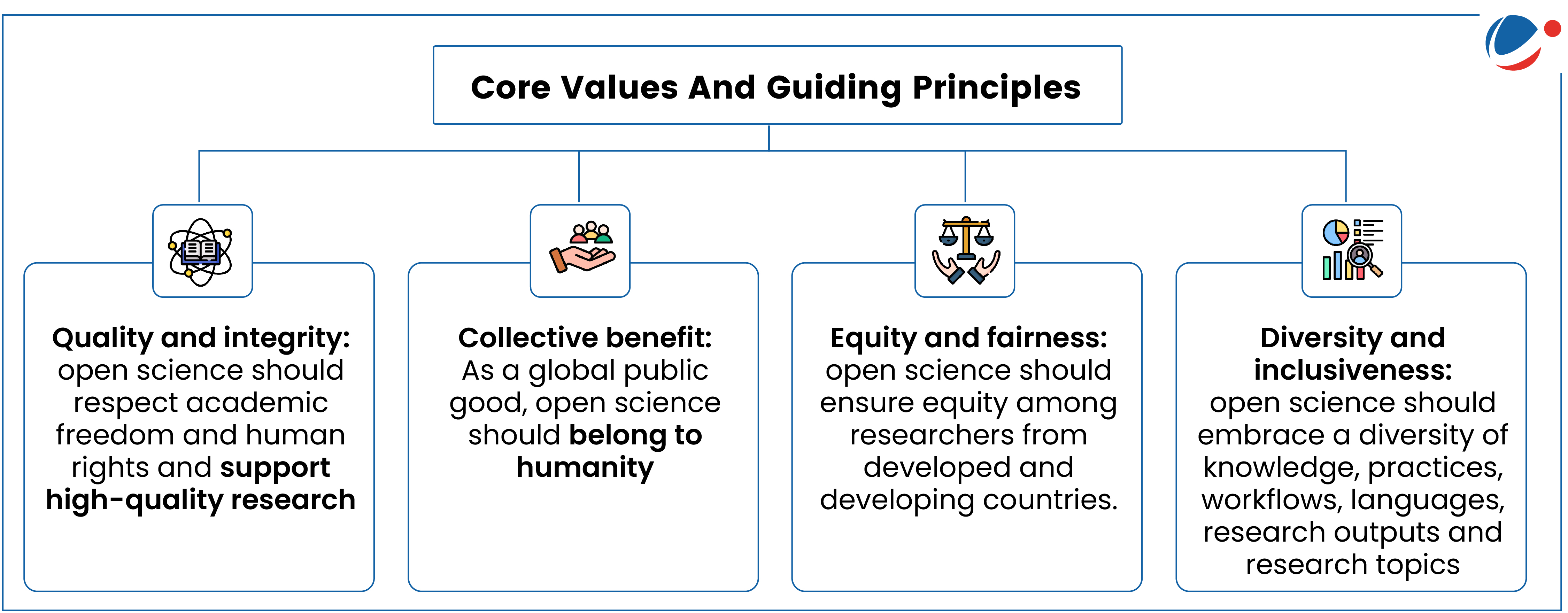
An image showing core values of Open Science as provided by   ‘UNESCO Recommendation on Open Science’ adopted in 2021. Key Values include: Quality and integrity: open science should respect academic freedom and human rights and  support  high-quality  research; Collective benefit: As a global public good, open science should belong to humanity; Equity  and  fairness:  open  science  should  ensure  equity  among  researchers  from  developed  and  developing  countries; Diversity and inclusiveness: open science should embrace a diversity of knowledge, practices, workflows, languages, research outputs and research topics


Why is Open Science Threatened Due to AI? 

Open science benefits AI by providing data through participative research, however AI poses threat to open science due to: 

  • Reproducibility crisis: Other researchers cannot replicate experiments conducted using AI tools. 
  • Interdisciplinarity: Limited collaboration between AI and non-AI disciplines can lead to an inconsistent uptake of AI across science. 
  • Data challenges: While high quality data is foundational to AI applications, researchers consistently face challenges related to its volume, heterogeneity and potential for bias.
  • Changing incentives: Incentives across the scientific ecosystem may be increasing pressure on researchers to be ‘good at AI’ rather than ‘good at science’.


Addressing these challenges requires applying open science principles to AI, particularly focusing on transparency. 

Watch Video News Today

Explore Related Content

Discover more articles, videos, and terms related to this topic

RELATED VIDEOS

3
News Today (Jul 23, 2025)

News Today (Jul 23, 2025)

YouTube HD
Deep Dive with VisionIAS | AI’s Code for Humanity: Promise, Peril & Policy Pathways

Deep Dive with VisionIAS | AI’s Code for Humanity: Promise, Peril & Policy Pathways

YouTube HD
News Today (Apr 20-21, 2025)

News Today (Apr 20-21, 2025)

YouTube HD
Title is required. Maximum 500 characters.

Search Notes

Filter Notes

Loading your notes...
Searching your notes...
Loading more notes...
You've reached the end of your notes

No notes yet

Create your first note to get started.

No notes found

Try adjusting your search criteria or clear the search.

Saving...
Saved

Please select a subject.

Referenced Articles

linked

No references added yet
