


Why in news?
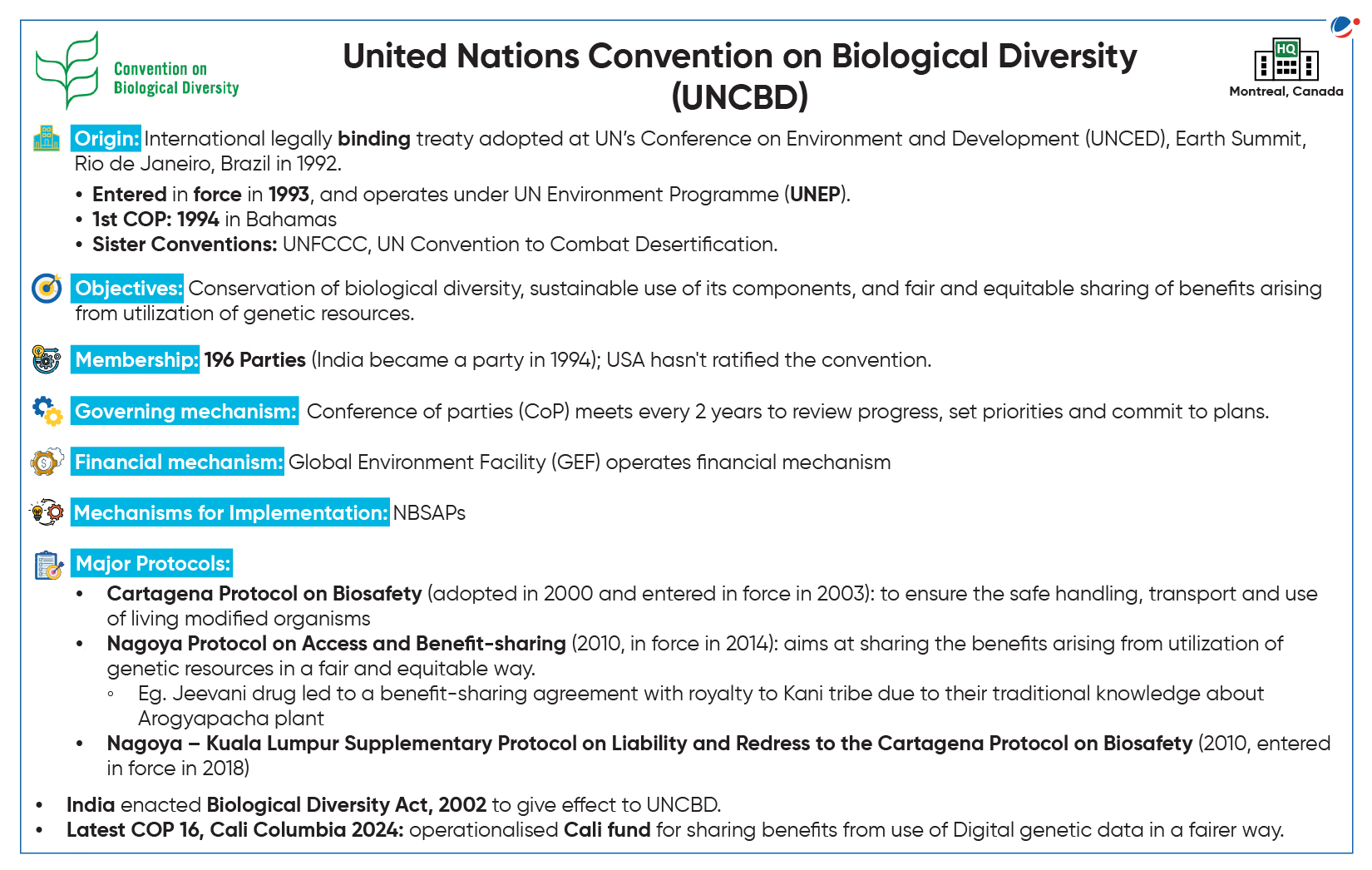
Ministry of Environment, Forest and Climate Change (MoEFCC), submitted 7th National Report under article 26 of Convention on Biological Diversity (CBD) (mandatory obligation under CBD)
More on News
- Reports track progress against 23 National biodiversity Targets (NBT) under updated National Biodiversity Strategy and Action Plan (NBSAP) (2024–30).
- It is the first full assessment of its progress since the adoption of the Kunming-Montreal Global Biodiversity Framework (KMGBF).
- Whole-of-government and whole-of-society approach: engages multiple stakeholders like ministries, NGOs, Women, states, Private sector, Indigenous peoples in updating its strategy.
Kunming Montreal Global Biodiversity Framework
|
Key Highlights of the Report
- Policy & Targets: All 23 revised NBSAP targets (142 indicators) are on track and align with the KMGBF.
- Forest & Carbon: Forest and tree cover increased to 25.17% of geographical area (recorded forest: 23.59%).
- Forest carbon stock reached 7,285.5 million tonnes (55% is soil organic carbon).
- Ecosystem Restoration: 24.1 million hectares (mha) restored or under restoration.
- India is nearing its Bonn Challenge pledge of 26 mha by 2030.
- Wetlands: 98 Ramsar sites as of 2026 (up from 26 in 2014).
- Ranks 1st in Asia and 3rd globally for Ramsar sites.
- Populations: 3,682 Tigers (>70% of global total), 22,446 Elephants, >4,000 Rhinos, and 891 Asiatic Lions.
- First Assessments: Recorded 718 Snow Leopards and 6,327 Riverine Dolphins.
- Protected Areas: Covers 5.71% of land area; marine protected areas have also increased.
- Network: 574 Wildlife Sanctuaries, 390 Community Reserves, 145 Conservation Reserves, 106 National Parks.
- Reserves: 58 Tiger, 33 Elephant, and 18 Biosphere Reserves.
- Tech Integration: Uses remote sensing, GIS, and DNA-based tools for monitoring.
- Parivesh portal utilized for environmental clearances and governance.
- Agrobiodiversity: 22 documented agrobiodiversity hotspots.
- Agroforestry occupies 8.65% of the country's geographical area.
Key Challenges in Biodiversity Management
- Limited Progress Clarity: While govt claims all targets on track, the report identifies only NBT-1 biodiversity-inclusive land and sea-use planning and NBT-2 are identified as being on track.
- For others, the report provides ongoing initiatives rather than clear projections.
- Land Degradation: Despite efforts, ~ 29.77% of India's area is currently undergoing degradation.
- Mangrove cover saw a declined in 2023 wrt 2021.
- Stagnant Coastal Planning: Only 3/13 coastal States approved Integrated Coastal Zone Management Plans due to evolving regulatory requirements (FY 2020–24).
- Data collection issues: Advancements in satellite technology make it difficult to compare current data with previous assessments, fragmented data across ministries etc.
- Invasive Species Expansion: Especially in tiger ranging state eg. Chromolaena odorata recorded rise of 70%. Prosopis juliflora, Mimosa diplotricha also increased.
Conclusion
India's 7th National Report to the CBD underscores a nation making significant strides toward its global environmental commitments, yet simultaneously grappling with complex domestic realities. Through its alignment with the Kunming-Montreal Global Biodiversity Framework (KMGBF), India has demonstrated commendable leadership, evidenced by thriving flagship species populations, the rapid expansion of its Ramsar wetland network, and an ambitious push for ecosystem restoration.



