


Why in the news?
Recently, President has given assent to the Transgender Persons (Protection of Rights) Amendment Act, 2026.
Key Changes in Transgender Persons (Protection of Rights) Amendment Act, 2026
- It aims to amend the Transgender Persons (Protection of Rights) Act, 2019.
Aspects | Detail |
Revised Definition of Transgender Persons |
|
Issue of Certificate of Identity |
|
Verification Authority |
|
Change in Gender |
|
National Council for Transgender Persons |
|
Offences and Penalties | The Act adds certain offences.
|
Significance of Transgender Persons (Protection of Rights) Amendment Act, 2026
- Improved Implementation: Revised definition and identification process may help remove ambiguities in 2019 Act, reportedly making the law easier to enforce.
- Stronger Legal Safeguards: Introduction of graded punishments for serious crimes strengthens protection against exploitation and violence.
- Protection of Bodily Integrity: By penalising forced identity changes and bodily harm, bill reinforces the constitutional principle of dignity and bodily autonomy.
Issues associated with Transgender Persons (Protection of Rights) Amendment Act, 2026
- Loss of Right to Self-Identification: The shift from self-identification to institutional validation undermines person's autonomy and dignity in identity determination.
- Exclusion due to narrow Definition: Unlike the 2019 Act, the Bill effectively exclude trans-men, non-binary people, and gender-queer individuals from legal protection.
- Bureaucratic Barriers: Identity recognition depends on a Medical examination and a recommendation to the District Magistrate, which may lead to delays, discretion, and risks of exclusion.
- Medical gatekeeping: Bill mandates surgery or hormonal treatment and approval by a medical board for legal recognition, undermining personal autonomy under Article 21.
- Legal disparity: It treats sexual abuse of transgender persons on par with minor offences and prescribes only up to 2 years' punishment, unlike harsher penalties for rape of cisgender women, reflecting discriminatory and unequal legal protection.
Other Issues associated with Transgenders in India
- Data Deficiency: 2011 Census estimated 4.8 lakh transgender persons, but actual numbers likely higher, due to societal prejudice, lack of clear definition of transgender leading to underreporting.
- Educational Exclusion: The total literacy rate has been reported to be 56.1% among transgender persons, as against 74.04 % of the national average (Census of India, 2011).
- Economic Marginalization: As per NHRC (2018), nearly 96% of transgender persons face discrimination in employment, with only about 6% engaged in formal sector jobs.
- Healthcare Barriers: Transgender individuals face restricted access to gender-affirmative healthcare, with around 27% reportedly being denied medical services due to their gender identity (NALSA).
- HIV prevalence among transgender persons is 3.8% (≈20× national average).
- Human Rights Violations: Trans persons face physical, sexual, and verbal abuse due to widespread trans-phobia and institutional discrimination.
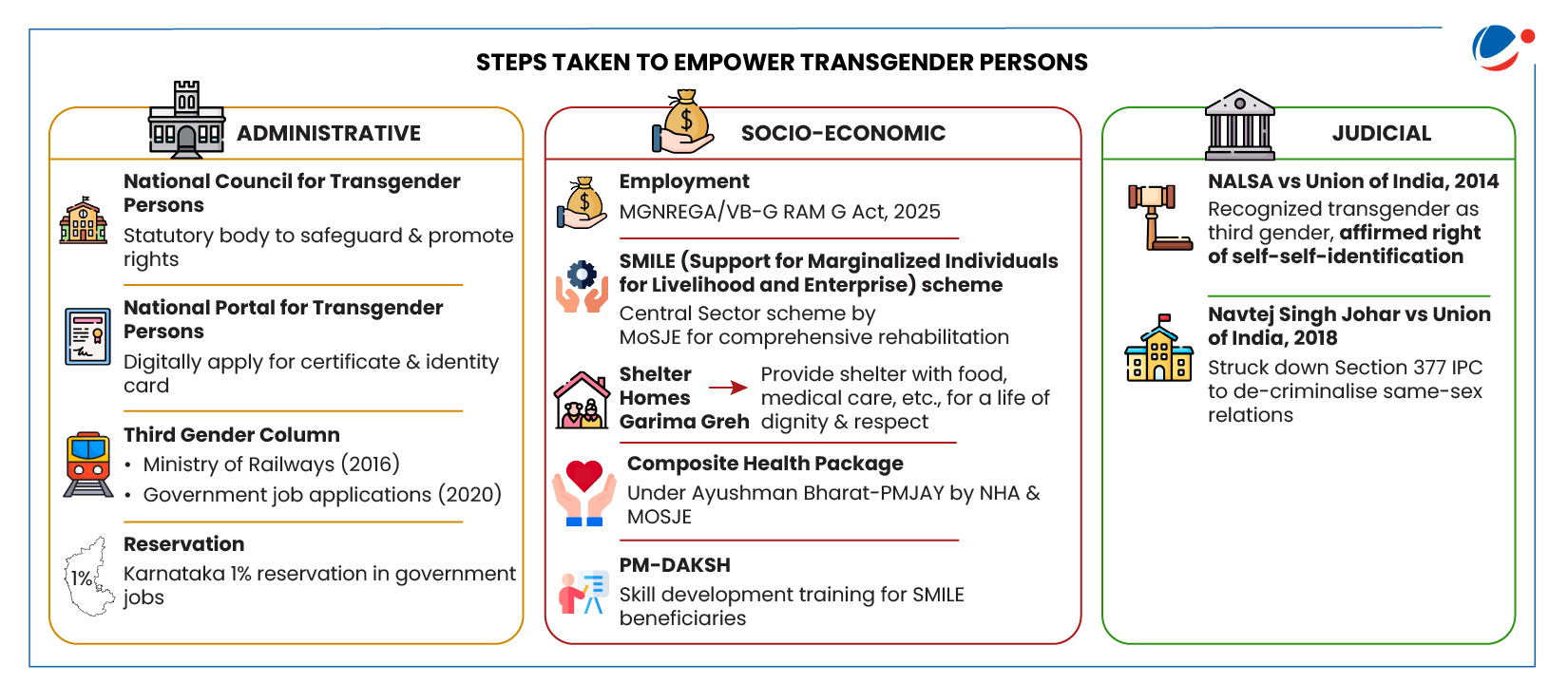
Way ahead
- Regular Survey: Conduct a dedicated national survey or Census update on transgender population, and use data-driven policymaking for targeted welfare delivery.
- Legal & Institutional Reforms: Law can be aligned with the Yogyakarta Principles (YP) by ensuring that gender recognition is based on self-identification, without mandating any medical procedures.
- YP address the broad range of human rights standards and their application to issues of sexual orientation and gender identity.
- YP were set up as a lot of 29 Principles with 29 signatories including India, USA, UK, etc. YP plus 10 was adopted in 2017.
- Awareness generation: Introduce gender-sensitization curriculum in schools and colleges, provide scholarships, hostels, and nationwide campaigns to reduce social stigma and generate awareness.
- Healthcare Reforms: Incorporate LGBTQIA+ inclusive content in pre and in-service training for health professionals, and expand mental health services and HIV prevention programs.
- Economic Empowerment: Private sector participation can be encouraged through diversity-focused hiring incentives and tax benefits, while promoting self-employment and SHGs to ensure sustainable livelihood opportunities for transgender.


