


Why in the News?
US and Israel launched coordinated military strikes on Iran in Operation Epic Fury which led to a prolonged conflict in the West Asian Region.
About the Conflict
- Large-scale US-Israel strikes targeted Iranian military assets and Iran's top leadership, killing Supreme Leader Ayatollah Ali Khamenei.
- Iran retaliated by targeting U.S. military facilities in the West Asian region, Israel, and energy and civilian infrastructure in the Gulf states.
Drivers of Conflict | Nation | Particulars |
Geopolitical Interests | Israel | Permanently neutralize Iran's nuclear program and dismantle the "Axis of Resistance" (Iran led militias in Lebanon, Yemen, Iraq, and Syria). |
United States | Maintain regional dominance, regime change and eliminate Iran as a strategic threat to US interests. | |
Geoeconomic Interests | United States | Secure maritime energy flows to Indo-Pacific allies, manage global oil prices, and advance pacts like the Abraham Accords and I2U2. |
Nuclear Concerns | US & Israel | Act on assessments that Iran's nuclear and ballistic missile programs are nearing technically irreversible thresholds. |
Iran | Contravened Joint Comprehensive Plan of Action restrictions by significantly boosting uranium enrichment following the US withdrawal from the deal. | |
Regional Proxies | Iran | Actively funds, arms, and trains regional militant groups (Hamas, Hezbollah, Houthis, and Shiite militias) via the IRGC Quds Force. |
Cost of War in Middle East
Category | Impact Area | Key Details |
Human Cost | Rising Costs | Higher fuel and freight costs squeeze purchasing power, worsening food insecurity and straining budgets/livelihoods. |
Development Loss | Iran suffers the sharpest HDI decline, losing 1 to 1.5 years of human development progress. | |
Poverty | Rising costs risk pushing 8.8 million people across 14 countries (over 5 million in Iran alone) into poverty. | |
Livelihoods | Gulf labor disruptions trigger immediate employment and income shocks for migrant workers and their families. | |
Environmental Cost | Air Pollution | Bombed refineries (Tehran, Aghdesieh, Shahran, Karaj) released toxic hydrocarbons, sulfur/nitrogen compounds, heavy metals, and PFAS, creating a toxic legacy. |
Health Crisis | Toxic exposure causes preterm births, low birth weights, and impaired lung growth, especially in pregnant women and children. | |
Water Crisis | Damage in water-stressed Iran risks systemic collapse, worsening unemployment, displacement, weak governance, and food price volatility. | |
Pollution | Bombed oil, chemical, and weapon sites leave toxic residues in soil and cross-border waterways. | |
Economic Cost | Geoeconomic Risk | WEF's 2026 Global Risks Report ranks armed conflicts as major factor reshaping global markets, supply chains, and geopolitics. |
Port Congestion | The Strait of Hormuz closure forced longer shipping routes and caused massive global port congestion. | |
Stagflation | Strikes on Iranian energy hubs (Kharg Island, South Pars) pushed Brent crude past $110/barrel. Middle East shipping insurance spiked 50%, driving permanent global inflation. | |
Logistics | War-driven shipping and insurance surcharges are rippling globally (e.g., from Taiwanese fabs to Brazilian farms and South Korean steel mills). | |
Supply Chains | The conflict cut ~33% of the global helium supply, critically disrupting semiconductors, medical imaging, and high-tech sectors. | |
Sovereign Debt | Record-high developed-nation debt could worsen with monetary tightening; Asian economies (Indonesia, Malaysia, Thailand) face widening fiscal deficits. | |
Food Security | Input Costs | In the past month, urea fertilizer prices jumped ~30%, and soybean oil hit a two-year high. |
Fertilizer Constraints | Fertilizer imports coming from the Middle East, energy disruptions directly hit agricultural supply chains. |
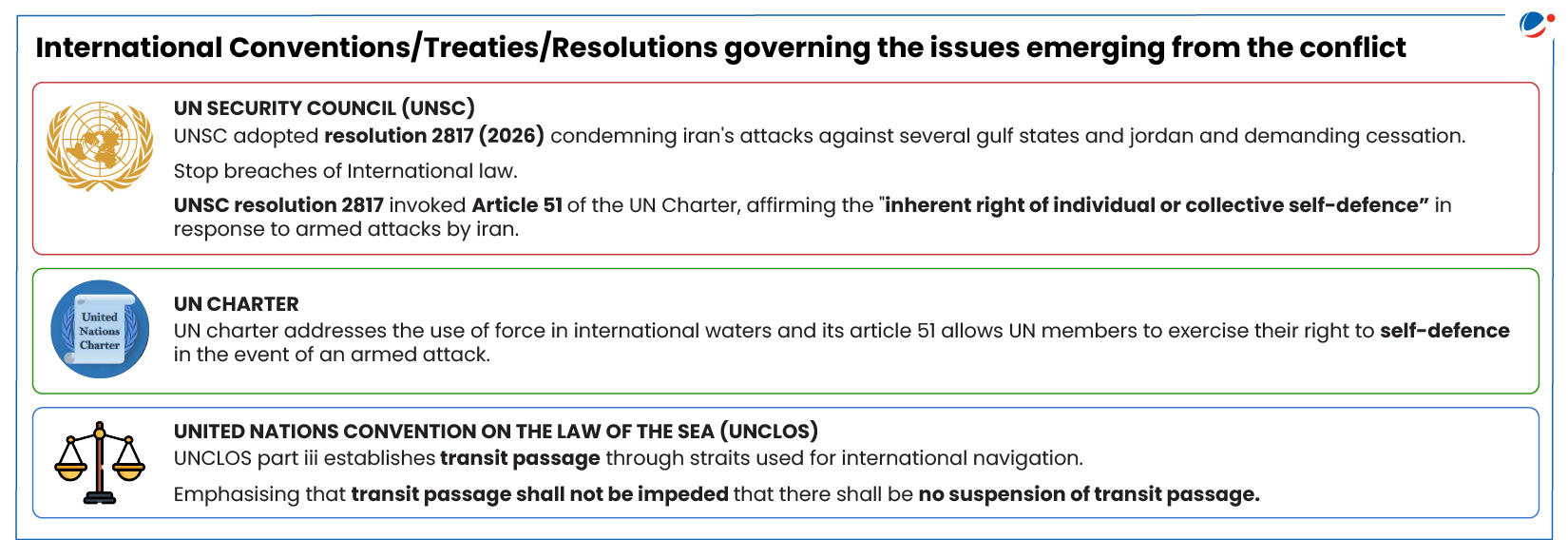
Impact on India
- Energy Imports: ~50% of India's oil (2.5–2.7 million bpd) transits the Strait of Hormuz. Every $1/barrel price increase adds $1.8–$2 billion to India's annual import bill.
- Gas Reliance: The Strait handles 80–85% of India's LPG and 60% of its LNG imports.
- Agriculture: Global fertilizer prices surged 40% due to the rising cost of natural gas, which accounts for 70% of urea and ammonia production costs.
- India's urea subsidy budget sits at ~$12.7 billion this fiscal year, creating a massive public expense.
- Geopolitics: The conflict functionally paralyzed the India-Middle East-Europe Economic Corridor (IMEEC) and complicates broader connectivity plans with Iran and Central Asia.
- Security Limitations: India's need to balance diplomatic relations has exposed the limitations of its naval role as a regional security provider in the Indian Ocean.
- Diaspora Safety: The security of approximately 10 million Indian nationals living and working in the Gulf is a paramount national concern.
India's Measures
- Evacuation: India executed rapid, large-scale evacuation protocols utilizing civil aviation assets and with help from countries like Armenia and Azerbaijan.
- Supply Chain Diversification: Union Government established seven inter-ministerial empowered groups functioning as rapid-response teams.
- Oil and Gas: The government is rigorously managing its strategic petroleum reserves and is actively sourcing additional Regasified LNG (RLNG) from spot markets to maintain pipeline hydraulics for prioritized domestic consumers.
- Agriculture: Department of Fertilizers initiated emergency global procurement protocols and India is proactively diversifying its sourcing to Russia, Morocco, Australia, Canada, Indonesia, and Egypt.
- Diplomatic Channels: Prime Minister has engaged directly with leadership across West Asia.
- Economic Stabilization Fund: Government has proposed the creation of an INR ₹573 billion (USD $6.20 billion) economic stabilization fund to manage external shocks and supply chain disruptions.
Conclusion
Driven by geopolitical and nuclear anxieties, the conflict has escalated into a regional war that weaponized chokepoints like the Strait of Hormuz and exposed the severe fragility of global supply chains. For India, these vulnerabilities demand a long-term strategic reassessment requiring India to accelerate its green energy transition, permanently diversify critical supply chains beyond the volatile Persian Gulf.


