


Parliamentary Standing Committee in its report analysed performance of IndiaAI Mission.
Issues & Recommendations of IndiaAI Mission
Key Issues | Recommendations |
Under-utilization of Funds: Mission utilized only 32% of its Revised Estimate (RE) in FY 2025-26 (as of Dec 2025). Consequently, 2026-27 Budget Estimate (BE) allocation was halved against proposed requirements. | Financial Discipline: Committee urged MeitY to strengthen financial discipline, accelerate implementation across all pillars, and optimize spending. |
Infrastructure Bottlenecks: Despite development of GPUs clusters, major issues exist like high cost of hardware, global supply chain delays and tax holiday. | Stakeholder Consultation: MeitY must conduct extensive stakeholder consultations to mitigate adversities related to hardware procurement and global supply constraints. |
Environmental Impact: Establishing massive computing infrastructure involves huge power and water consumption by data centres. | Environmental Mitigation: MeitY should consult environmentalists to address ecological impact of setting up sovereign data centres. |
R&D and Inclusivity Constraints: There are specific challenges in developing a sovereign AI model. Additionally, AI research funding remains largely restricted to premier institutions like IITs and national laboratories, limiting broader ecosystem growth. | Broader R&D Evaluation: MeitY needs to assess the real-life impact of new initiatives, such as the Anusandhan National Research Foundation and the Research Development and Innovation Fund, to democratize research. |
Article Sources
1 sourceIISc and Pratiksha Trust launched Moonshot project on Brain Co-processors.
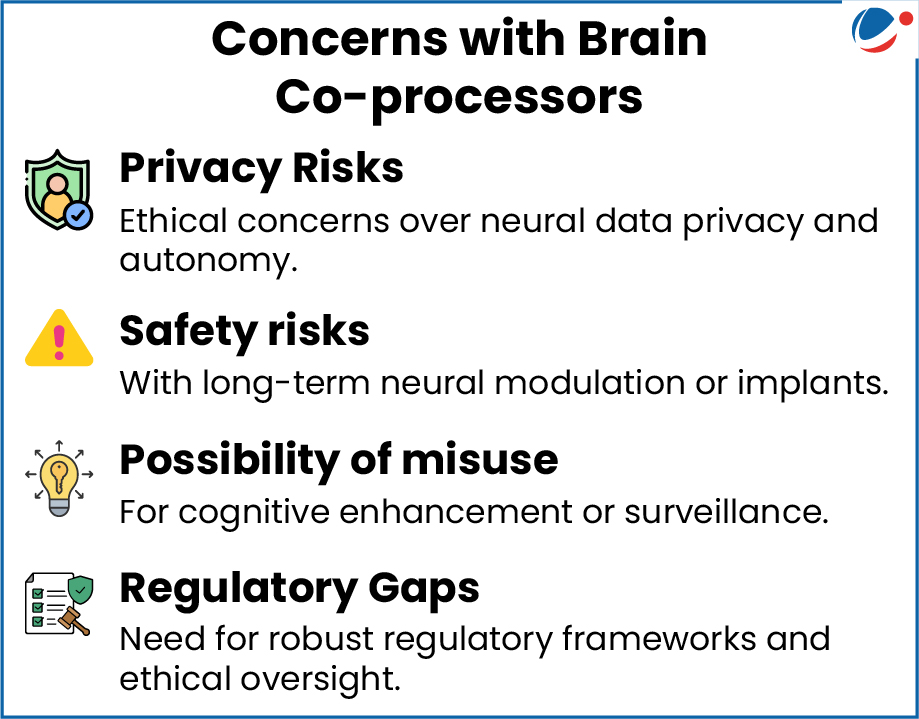
- The Moonshot project aims to develop both implantable and non-invasive brain co-processors capable of decoding neural activity from brain recordings, processing and re-encoding the signals back into the brain using neural stimulation.
About Brain Co-processors
- They are AI-powered, bidirectional neural interfaces that decode, analyze, and re-encode brain signals.
- Unlike conventional BCIs (Brain-Computer Interface), they target the full cognitive loop i.e., perception, attention, decision-making, and motor control.
- Primary goal: Restore reach and grasp in stroke survivors.
About Non-invasive Brain Stimulation (NIBS)
- A technique that modulates brain activity without surgical implantation.
- It uses methods such as Transcranial Magnetic Stimulation (TMS) and Transcranial Direct Current Stimulation (tDCS).
- TMS and tDCS do not require electrodes on the bare brain and are applied to research on neurological, psychiatric, and neurodegenerative disorders.
V.O. Chidambaranar Port Authority became the first port in India to launch Digital Twin initiative.
- V.O. Chidambaranar Port (earlier Tuticorin Port), one of 13 major ports in India, is an artificial deep-sea harbour located in Thoothukudi (Tamil Nadu).
- Its history dates to as early as 123 AD when Ptolemy from Greece described Tuticorin as a flourishing trade centre engaged in Maritime Trade with Western and Eastern Countries.
- Tuticorin has been centre for Pearl Fishery for centuries.
About Digital Twin Initiative
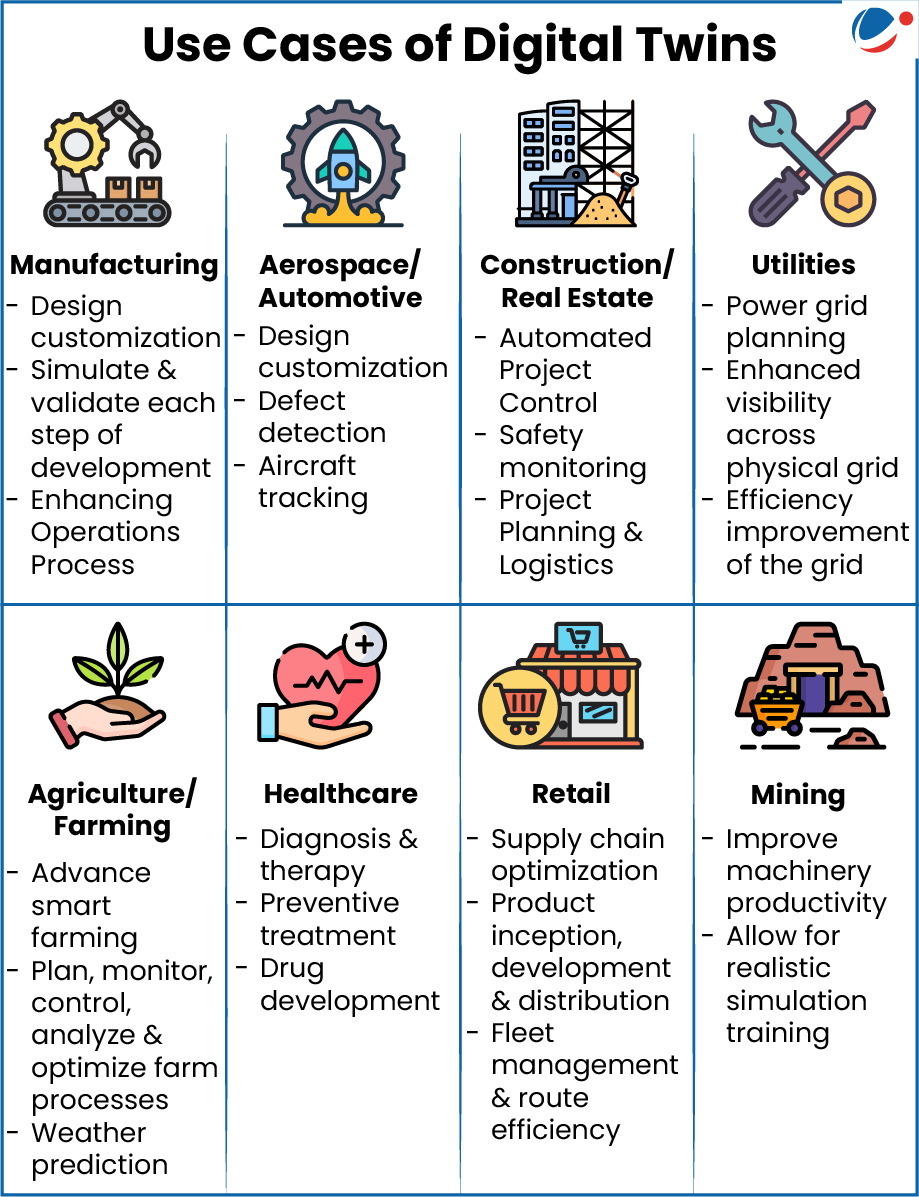
- Digital Twin is a virtual representation of a physical object or system that uses real-time data to accurately reflect its real-world counterpart’s behavior, performance and conditions.
- Digital twins enable continuous monitoring, simulation and analysis of an object, product or system over the course of its lifecycle, from design and production to maintenance and decommissioning.
- Digital Twin for Port Management: It will create a real-time virtual replica of the port’s infrastructure, operational assets, and maritime ecosystem, enabling enhanced operational visibility, predictive analytics, and data-driven decision-making across the port.
- Technologies: The platform will useIoT sensors, GPS tracking, LiDAR mapping, drone imaging, and CCTV networks etc.
Article Sources
1 sourceAs per reports, the Union government has initiated airwave spectrum allocation for ‘vehicle-to-everything’ or V2X technology.
About V2X Technology
- It enables vehicles to communicate with each other (V2V), with other road users such as pedestrians and cyclists (V2P), and with roadside infrastructure (V2I).
- Benefits: Enhanced Road Safety (e.g., helps vehicles see vulnerable road users), Improved Traffic Efficiency, etc.
Article Sources
1 sourceIndian Railways approved extension of KAVACH system across multiple zones.
About KAVACH (Automated Train Protection (ATP) system)
- It is a Train Collision Avoidance System (TCAS) that prevents collisions by automatically applying brakes if 2 trains are on a collision course.
- Developed by: Research Designs & Standards Organization (RDSO) of Indian Railways.
- Key features
- Continuous real-time updates to the locomotive.
- Prevention of all types of train collisions: head-on, rear-end, and side-on. (loco to loco communications).
- Prevents Signal Passing at Danger.
- Others: Repeats line-side signal for foggy weather, Automatic horn activation, Emergency Stop-on-Sight (SoS) messages.
Article Sources
1 sourceIndia’s largest pregnancy cohort study of 12,000 women under the GARBH-INi initiative is aimed at developing indigenous, AI-driven solutions to address preterm births, informed the Union Minister of Science & Technology.
About GARBH-INi
- It is a flagship programme supported by the Department of Biotechnology (DBT).
- Aim: To reduce adverse pregnancy outcomes.
- The initiative has also established a national biorepository and GARBH-INi-DRISHTI data-sharing platform, enabling wider access for the research community.
- GARBH-INi pregnancy cohort is one of the largest pregnancy cohorts in South Asia established from 2015 onwards at Gurugram Civil Hospital.
Article Sources
1 sourceMinistry of Heavy Industries invited bids to set up integrated manufacturing facilities under the Scheme to Promote Manufacturing of Sintered Rare Earth Permanent Magnet (REPM).
About Scheme to Promote Manufacturing of Sintered REPM
- Aim: To establish 6,000 Metric Tons per Annum (MTPA) of integrated REPM manufacturing facilities,
 involving conversion of rare earth oxides to metals, metals to alloys, and alloys to finished REPMs.
 - Beneficiary allocation: 5 beneficiaries selected through global competitive bidding process, each to be allotted up to 1,200 MTPA of capacity.
- Financial outlay: Rs.7,280 crores- Capital subsidy: ₹750 crore, Sales-linked incentive: ₹6,450 crore
About REPM
- They are one of the strongest types of permanent magnets, made from alloys of rare earth elements.
- Examples: Neodymium-Iron-Boron.
- Applications: Electric vehicles, renewable energy, electronics, aerospace, and defence applications.
Article Sources
1 sourceReleased by World Obesity Federation, the Atlas provides global, regional and national estimates of rising obesity among children and adolescents.
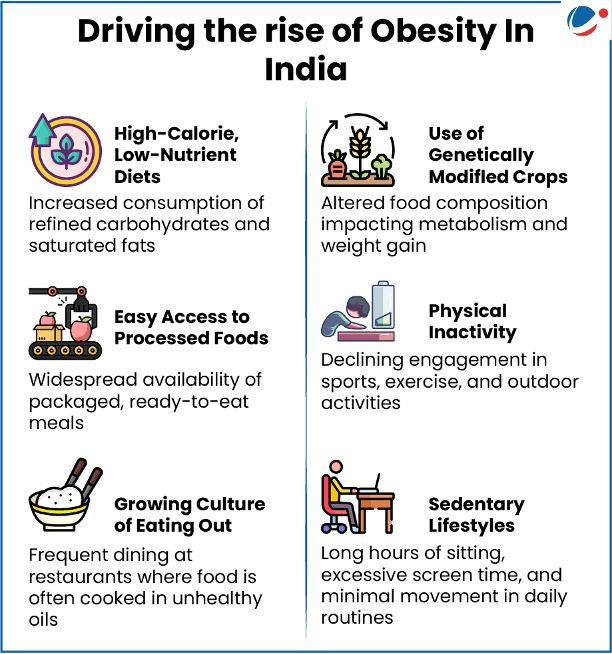
- Obesity is classified by the World Health Organization (WHO) as a chronic, relapsing disease characterising abnormal or excessive fat accumulation that presents a risk to health.
- Its diagnosis is made by measuring people’s weight and height and by calculating the Body Mass Index (BMI): weight (kg)/height² (m²).
- For school-age children (aged 5-19 years), obesity is greater than 2 standard deviations above the WHO Growth Reference median.
Key Highlights of the Report
Global Scenario
- Obesity: Prevalence of obesity among school-age children (aged 5-19 years) has increased from 4% in 1975 to nearly 20% in 2022.
- The majority resides in middle-income countries.
- Implications: Obesity in childhood frequently persists into adulthood, increasing the risk of Non-Communicable Diseases (NCDs) such as diabetes, heart disease, and certain cancers.
- High Burden Countries: Ten countries (with highest burden in China, India, and US) alone account for over 200 million school-age children with high Body Mass Index (BMI).
Indian Scenario
- High Burden: India ranks second globally for children who are overweight and living with obesity.
- 41 million school-age children in India have high BMI.
- High chronic disease indicators: In 2025, about 8.39 million children had BMI-attributed metabolic dysfunction-associated liver disease (MASLD), while 2.98 million suffered from BMI-attributed hypertension.
The Central Drugs Standard Control Organisation (CDSCO) has prohibited pharmaceutical companies from advertising GLP-1 drugs amid growing concerns of rampant misuse.
About GLP-1 (glucagon-like peptide-1 receptor agonists) drugs
- They are a class of medications that mimic the natural GLP-1 hormone, helping regulate blood sugar levels and appetite.
- These drugs include Ozempic, Wegovy, etc.
- They were originally used for managing type 2 diabetes, but are now also used for reducing obesity and weight loss.
- They slow down the process of food digestion and increase feelings of fullness, leading to a reduction in food intake.
- Some GLP-1 drugs lower the risk of heart attack, stroke, and heart failure, and reduce the incidence of type 2 diabetes, kidney and liver disease among other outcomes.
Recently in news, fat cells (both white fat and brown fat) can become a promising target for future weight-loss therapies as they burn energy to make heat.
About White Fat and Brown Fat
- White Fat is the most abundant fat in adults and Brown Fat is mainly found in neck and upper chest.
- Primary Function: White Fat stores energy in the form of triglycerides.
- Brown Fat burns energy and dissipates calories; converts chemical energy into heat.
- White Fat acts as a powerful endocrine organ, releasing hormones like leptin (to reduce appetite) and adiponectin (to regulate insulin and blood sugar).
- Brown Fat is naturally triggered by the brain upon exposure to cold temperatures to generate heat.
Scientists at CERN successfully transported antiprotons by road for the first time.
- It is significant because antimatter usually annihilates on contact with matter, which made transport very difficult earlier.
About Antiprotons
- They are antimatter particles identical to a proton in mass and spin but carrying an opposite (negative) electric charge.
- They were first produced and identified by Emilio Segrè and Owen Chamberlain (for which they received the Nobel Prize for Physics in 1959).
- Experiment will help in solving the Matter–Antimatter Mystery.
- The Big Bang should have produced equal matter and antimatter, yet the universe is dominated by matter.
Astronomers using the MeerKAT telescope discovered the brightest and most distant megamaser.
- MeerKAT located in South Africa is a precursor to the Square Kilometre Array (SKA) telescope.
About Megamaser
- It is essentially a giant beam of electromagnetic radiation emitted when a pair of galaxies violently merge.
- During the cosmic collisions, giant clouds of gas are compressed, exciting large reservoirs of hydroxyl (OH) molecules that release high-energy microwaves.
- This is similar to human-made lasers, which work by exciting particles and then amplifying the resulting light waves with mirrors.
- But for masers, microwaves are amplified instead of visible light.
- These rare objects act as cosmic signposts, revealing critical details about galaxies in the early universe.
Scientists tracing small molecular clouds located near the Milky Way disc have seen the skeleton of the magnetic field surrounding them for the first time to better understand its role in star formation.
About Molecular Clouds:
- It is an interstellar cloud of gas and dust in which molecules can form, the most common of which is hydrogen (H2).
- It is generally thought that our Sun formed in a similar molecular cloud by collapse of the cloud triggered by nearby supernova.
- Key features: It is opaque because of its internal dust grains. The form of such dark clouds is very irregular: they have no clearly defined outer boundaries.
Article Sources
1 sourceCouncil of Scientific and Industrial Research- National Chemical Laboratory (CSIR-NCL) has developed a Dimethyl Ether (DME) production process technology.
- DME can be considered as a ‘Second Generation fuel/bio-fuel’ and used as a sustainable alternative to LPG.
About Dimethyl Ether (DME)
- Nature: Colourless gas, slight ethereal odour, liquefies under pressure.
- Properties: Inert, non-corrosive, non-carcinogenic, low toxicity, does not form peroxides by prolonged exposure to air.
- Applications: Fuel, aerosol propellant, solvent, and refrigerant.
- Advantages as a fuel: Clean burning with minimal SOx, NOx, soot, particulate matter; comparable calorific value and thermal efficiency to traditional fuels; can be blended with LPG (up to 20%); can be produced from Indian coal, methanol, or captured CO₂, etc.

