


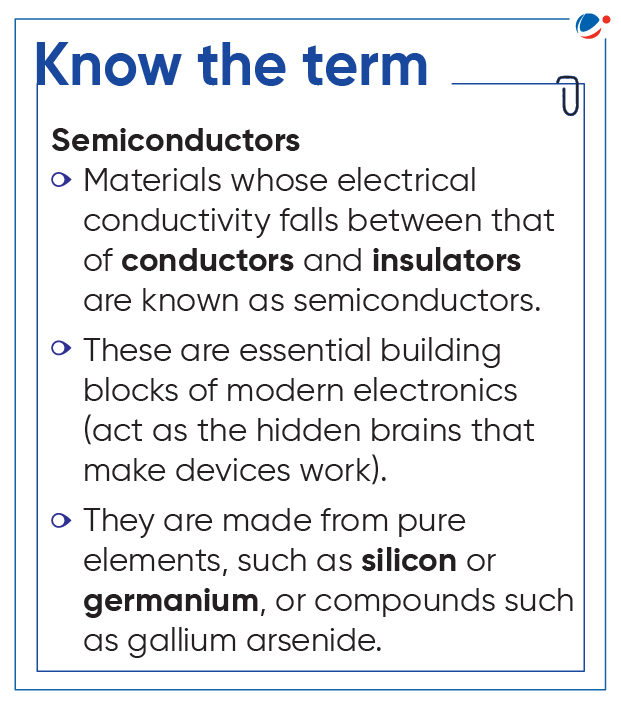
Why in the News?
The Prime Minister inaugurated India's First Semiconductor Assembly, Test, Marking, and Packaging (ATMP) facility in Sanand, Gujarat.
More on the News
- The plant by Micron Technology has started India's first commercial semiconductor chip production.
- This is a key step towards building a trusted, resilient, and self-reliant semiconductor ecosystem.
- It will also enhance India's participation in the global semiconductor value chain.
Status of Semiconductor Ecosystem in India
- India's semiconductor market is valued at $52 billion in 2024-25.
- The market is set to hit $100–110 Bn by 2030.
- India currently meets only ~10% of its semiconductor demand domestically.
- Key Growth drivers: Electronics manufacturing (e.g., India is the second-largest smartphone manufacturer in the world), rising demand for electric vehicles, etc.
Need for Building Indigenous Capacity in Semiconductor Manufacturing
- Reducing dependence on Imports: India imported $1 billion worth of semiconductors annually for defence needs (2024).
- It is also critical for telecom (5G/6G), AI, space, and digital infrastructure.
- Vulnerability of Concentrated Supply Chains: Taiwan alone accounts for over 60% (remaining South Korea, Japan, China, and the United States) of global semiconductor manufacturing and nearly 90% of the most advanced chips.
- The world witnessed an acute shortage of chips following the Covid 19 pandemic and the Ukraine-Russia war.
- Export Potential: Boosts electronics manufacturing and attracts FDI, helping India capture a substantial share of the $1 trillion semiconductor market by 2030.
- Also,it will create high-value manufacturing jobs and stimulate upstream and downstream sectors, including equipment, materials, and tools.
Key Initiatives taken to Support Semiconductor Ecosystem
- India Semiconductor Mission (ISM) & Semicon India: ISM is the nodal agency driving the country's long-term semiconductor sector. In the Union Budget 2026–27, ISM 2.0 has been announced. ISM includes four primary schemes:
- Semiconductor Fabs Scheme
- Display Fabs Scheme
- Compound Semiconductors & ATMP/Outsourced Semiconductor Assembly and Test (OSAT) Scheme
- Design Linked Incentive (DLI) Scheme
- Talent and Skill Development: It includes Chips to Start-up (C2S) Programme, AICTE Curriculum Updates (introduced specialised engineering programs), etc.
- Indigenous Microprocessors and Core Technologies: Microprocessor Development Programme (MDP) and the Digital India RISC-V (DIR-V) Programme have led to the creation of native open-source processors like SHAKTI, VIKRAM, etc.
- A major milestone is the recent launch of DHRUV64, a fully indigenous 64-bit microprocessor developed by C-DAC for applications in 5G, IoT, and industrial automation.
- Global Collaboration: E.g., India- U.S. Initiative on Critical and Emerging Technology (iCET), U.S.-led Pax Silica Initiative, etc.
- Other: Scheme for Promotion of Manufacturing of Electronic Components and Semiconductors (SPECS), Electronics Components and Manufacturing Scheme (ECMS), etc.
Way Forward
- Institution-Building: Emulating the success of Taiwan's Industrial Technology Research Institute (ITRI), India needs a dedicated institution like the proposed India Semiconductor Research Centre (ISRC).
- Building a Massive Talent Pipeline: Integrating harmonized semiconductor programs into mainstream engineering, such as the AICTE's new curricula for Integrated Circuit (IC) manufacturing.
- Scaling Startups and Indigenous R&D: There is a need to move beyond assembly and into core innovation.
- Transitioning to Next-Generation Materials: The industry must also support the shift from traditional silicon to Silicon Carbide (SiC) semiconductors and 3D Glass packaging.
- These are essential for high-temperature and high-voltage applications like defence.
- Enhancing State-Level Coordination and Infrastructure: States like Gujarat, Tamil Nadu, and Odisha are setting precedents by providing streamlined regulations, harmonized power, etc.
- Forging Strategic Global Partnerships: Actively engaging in global collaborations and hosting platforms like SEMICON India, and integrating India into the supply chains of established semiconductor nations like the US, Japan, etc.
Conclusion
India's semiconductor push marks a decisive shift from import dependence to technological self-reliance, strengthening economic and strategic security. With sustained policy support, investments, and global partnerships, India is poised to emerge as a key player in the global semiconductor value chain.


