


Why in the news?
Recently, Central Adoption Resource Authority (CARA) has issued memorandums to all State Adoption Resource Agencies (SARAs) across States and Union Territories (UTs) to reinforce compliance with adoption procedures.
More on the news
- These directions have been issued in accordance with provisions of the Juvenile Justice (Care and Protection of Children) Act (JJ Act), 2015 (as amended in 2021) and Adoption Regulations, 2022.
- Key Directions
- Mandatory Strict due process: No orphan or abandoned child can be declared legally free for adoption without completion of due inquiry, tracing of biological parents within prescribed timeframe.
- In cases of surrendered children, mandatory reconsideration period of two months must be strictly followed before the child can be declared legally free for adoption.
- Record management: All adoption records to be securely preserved and properly transferred, even if institutions shutdown.
- Prohibition on disclosure of child identity: States/UTs ensure strict compliance with Section 74 (JJ Act 2015), prohibiting identity disclosure of children in conflict with law or children in need of care/ protection.
- Mandatory Strict due process: No orphan or abandoned child can be declared legally free for adoption without completion of due inquiry, tracing of biological parents within prescribed timeframe.
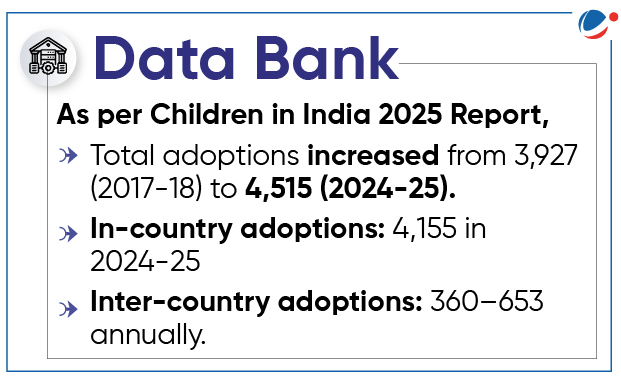
Child Adoption in India
- CARA is a statutory body under Ministry of Women and Child Development that functions as nodal body for adoption of Orphan, Abandoned and Surrendered Children through its associated /recognised adoption agencies.
- CARA was established in 1990 and was later granted statutory status under the JJ Act 2015, CARA monitors In-country (domestic) adoptions.
- It is also designated as Central Authority to deal with Inter-country (international) adoption in accordance with the provisions of Hague Convention on Inter-country Adoption, 1993 (Ratified by India in 2003).
- CARA also facilitates Relative Adoption, Adoption by Step Parents and Foster Adoption.
- SARA, Child Welfare Committees (CWCs), and District Child Protection Units (DCPUs) are responsible for adoption at the state or local level.
Framework of Child Adoption in India
- Hindu Adoption and Maintenance Act (HAMA), 1956: Permits adoption to Hindus, Buddhists, Jains, and Sikhs. Parents adopting a child under HAMA are not required to register adoption deed with CARA.
- Guardians and Wards Act, 1890: Governs guardianship, particularly for Muslims and Christians, as their personal laws do not recognise full adoption.
- JJ Act 2015: Provides for a comprehensive framework for adoption to everyone.
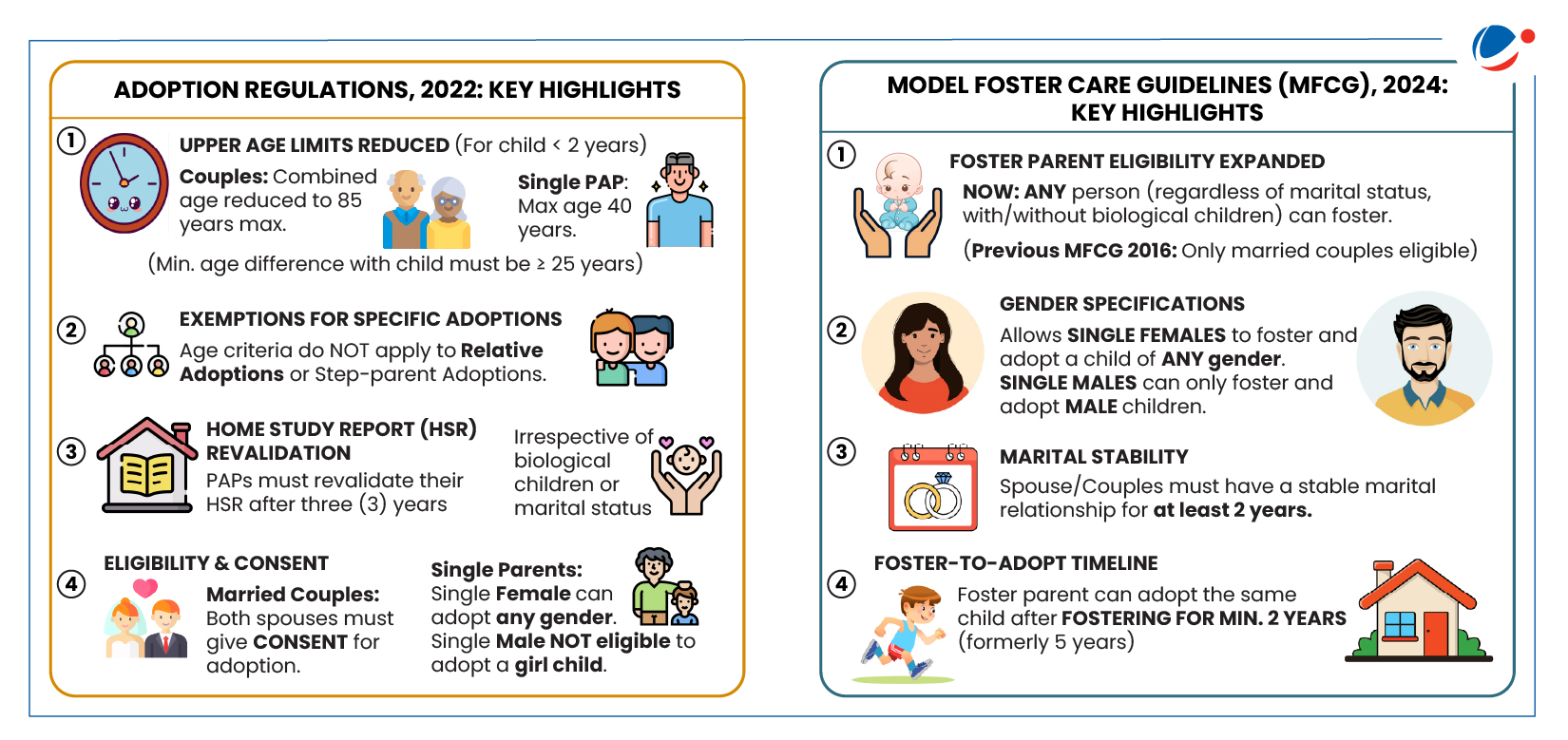
Initiatives taken to improve Child Adoption in India
|
Challenges associated with the process of Child Adoption in India
- Legal and Procedural Complexities: Adoption is governed by multiple laws such as JJ Act, 2015 and personal laws like HAMA, 1956 leading to overlapping jurisdictions.
- Demand Supply Mismatch: The number of prospective adoptive parents increased from 26,734 (2021) to 36,381 (2025), while children legally free for adoption rose marginally from 2,430 to 2,652.
- Delays in Processes and Identification: Slow inquiries, prolonged court processes, and weak inter-agency coordination delay adoption.
- In 2024, only 3,684 children were declared legally free, with just 2,177 entering the adoption pool, highlighting administrative bottlenecks.
- Increasing Waiting Periods: The average waiting time for prospective parents is nearly 3.5 years by 2025, which may drive illegal adoption in India.
- Low Adoption of Special Needs Children: Adoption of children with disabilities remains minimal, with only around 313–328 such adoptions (about 7% of total) in 2024–25.
- Preference bias: Many parents prefer children aged 0–2 and are reluctant to adopt older children.
Way ahead
- Legal Harmonisation: Streamline overlapping provisions under JJ Act 2015, and HAMA 1956 to create a uniform, child-centric legal framework.
- Introduce single-window digital clearance systems: To reduce documentation and procedural delays and shorten the adoption waiting period.
- Institutional Capacity: Increase staffing, training, and digital infrastructure to ensure efficient case handling and monitoring, and to strengthen coordination among CWCs, Specialised Adoption Agencies, and CARA.
- Promoting Adoption of Special Needs and Older Children: Provide financial incentives, medical support, and post-adoption care schemes for families adopting special needs children.
- Further, generate awareness through campaigns like National Adoption Awareness Month (November) to reduce stigma and build parental preparedness.
- Post-Adoption Support Systems: Provide counselling, follow-up services, and grievance redressal mechanisms for adoptive families, to ensure long-term integration and well-being of adopted children.
- Supreme Court held that Section 60(4) of Social Security Code, 2020 (previously Section 5(4) of Maternity Benefit Act, 1961), which allow maternity benefit to an adoptive mother only if the adopted child is less than 3 months of age, is unconstitutional.
Related News: Maternity Benefit for Adoptive Mothers
|

