


Why in the News?
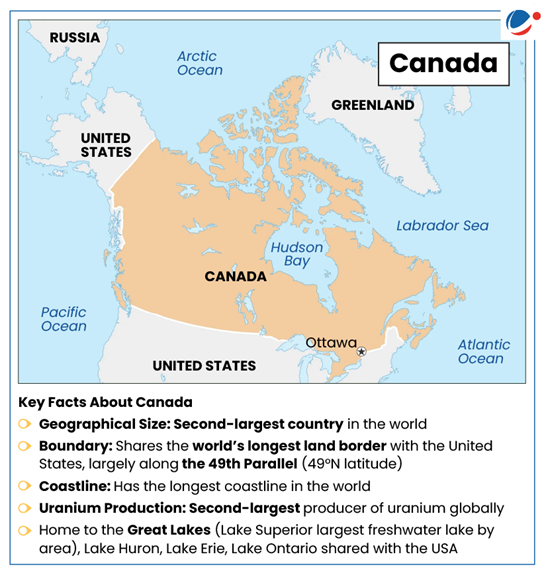
The Prime Minister of Canada visited India to strengthen bilateral relations and enhance cooperation in key areas.
Key outcomes of the visit
- Comprehensive Economic Partnership Agreement (CEPA) Negotiations: Signed the Terms of Reference (ToR) for CEPA, initiating negotiations for a comprehensive trade agreement to boost bilateral trade to $50 billion by 2030.
- Nuclear Energy: Agreement between India's Department of Atomic Energy and Cameco worth about $2.6 billion for supply of uranium ore concentrates (2027–2035) to fuel India's nuclear reactors.
- Critical Minerals: India–Canada MoU to build secure supply chains; focus on investment, technology sharing and cooperation in mining & processing.
- Renewable Energy: MoU to enhance cooperation in solar, wind, biomass & energy storage; includes knowledge sharing and capacity building.
- Multilateral: Canada to join Global Biofuels Alliance & International Solar Alliance; India supports its entry into the Indian Ocean Rim Association (IORA) as a Dialogue Partner.
- Declaration of Intent on Joint Pulse Protein Centre of Excellence: At National Institute of Food Technology, Entrepreneurship, and Management, Kundli (NIFTEM-K)
- Institutional: Establishment of India-Canada Defence Dialogue and Parliamentary Friendship Group.
- Others: Trilateral cooperation (India–Canada–Australia), All India Council for Technical Education (AICTE)–Mitacs partnership, and declaration of intent for Joint Pulse Protein Centre of Excellence at National Institute of Food Technology, Entrepreneurship, and Management, Kundli.
Significance of Uranium Deal with Canda
|
Significance of India-Canada Relations
- Economic and strategic Engagement: Expanding trade ties, with bilateral trade around USD 8.66 billion(2024-2025), indicating significant untapped potential.
- The two nations share over 75 years of diplomatic relations, which were formally upgraded to a "Strategic Partnership" in 2018.
- Energy Partnership: Cooperation in uranium, LNG, and critical minerals supporting India's long-term energy security
- Diaspora Linkages: Presence of around 1.8 million Indo-Canadians acting as a strong socio-cultural and economic bridge.
- Education & Mobility: Canada hosts around 4 lakh Indian students, strengthening human capital and people-to-people ties.
- Agriculture & Food Security: Canada's supply of pulses and fertilisers is crucial for India's food security and farm sector, e.g., Canada is the world's largest producer of Potash.
- Strategic Convergence: Both countries support a rules-based order in the Indo-Pacific, collaboration in climate initiatives and multilateral forums reflecting shared global interests, e.g., cooperation under G20, Canada's Indo-Pacific strategy, etc.
Issues in India-Canada Relations
- Khalistan Extremism: Presence of pro-Khalistan groups in Canada and incidents targeting Indian diaspora, consulates, and temples. E.g., Babbar Khalsa International (BKI)
- Nijjar Issue (2023): Allegations surrounding the killing of Hardeep Singh Nijjar led to a serious diplomatic crisis and a deep trust deficit.
- Diplomatic Strain: Expulsion of diplomats, suspension of visa services, and disruption of institutional dialogue mechanisms
- Statement on internal matters: e.g., Canadian statements on farm protests and minority issues in India
- Immigration & Mobility Issues: Decline in Indian students and tightening visa norms have affected people-to-people ties and educational exchanges
Conclusion
India and Canada can pursue a calibrated and pragmatic approach by addressing security concerns and respecting mutual sensitivities. Strengthening cooperation in trade, energy, and technology, along with leveraging diaspora linkages, can facilitate trust-building and enhance the overall bilateral partnership.

