


The scheme along with bringing in Rs. 15,000 crore of investment in SHP would support 51 lakh person days of employment, especially benefitting North Eastern (NE) and hilly states having high SHP potential.
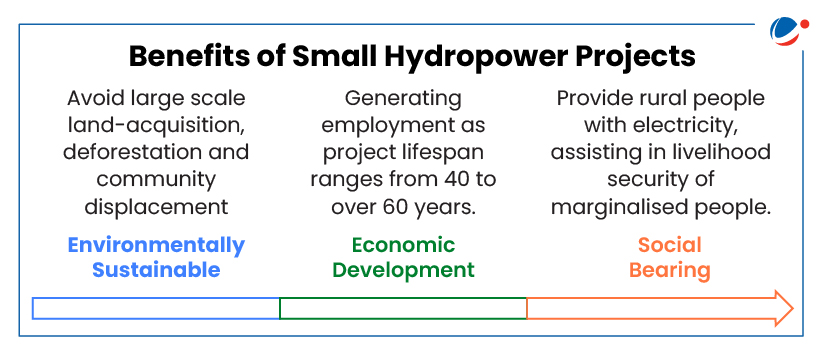
Key Features of the Scheme
- Duration and Capacity: FY 2026-27 to FY 2030-31 with an outlay of Rs.2584.60 crore for projects with approximate capacity of 1500 MW.
- Financial Assistance:
- NE & Border Areas: ₹3.6 crore/MW or 30% of project cost whichever is lower (up per limit of ₹30 crore/project).
- Other States: ₹2.4 crore/MW or 20% of project cost whichever is lower (upper limit of ₹20 crore/project).
- Detailed Project Report (DPR): Incentivize state and central government with an allocation of ₹30 crore towards ~200 DPR.
About Small Hydro Power (SHP) Projects
- Hydro Power plants with capacity of 25 MW or below are classified as Small Hydro in India.
- Could be either constructed on hill slopes utilizing small streams involving run of river type projects or on Canal Falls or Dam Toes.
- Ministry of New and Renewable Energy (MNRE) looks after their development.
- Estimated Potential: 21133 MW from 7133 sites for power generation in India (IIT Roorkee.).
- Hilly States mainly Arunachal Pradesh, Himachal Pradesh, Jammu & Kashmir and Uttarakhand constitute around half of this potential.
- Classification (Depending on the capacity): Micro (up to 100 kW); Mini (101 kW to 2 MW) and Small Hydro (2 MW to 25MW).
- State of the World’s Migratory Species: Interim Report (2026):
- Published by: Secretariat of Convention on the Conservation of Migratory Species of Wild Animals (CMS).
- Key Findings:
- Nearly 49% of CMS-listed migratory species show declining populations.
- About 24% of migratory species protected under CMS are globally threatened with extinction.
- UN World Water Development Report 2026:
- Published by: UN-Water base on the World Water Day 2026 theme ‘Water and Gender’.
- Key Findings:
- Lack of access: 2.1 billion people still lack access to safely managed drinking water globally.
- Gender Gap: Women and girls are primary collectors of water, spending over 250 million hours daily, limiting their access to education, income.
MoSPI released report titled Delivering Prosperity at Scale: India’s Economic Transformation through the SDGs.
Key Achievements highlighted in Report
Sphere | Key Progress | Initiative Taken |
Energy & Electrification (SDG 7) | Near-universal electrification achieved with coverage increasing from 99.77% to 100% | Saubhagya, DDUGJY, UDAY |
Renewable Energy (SDG 7) | Share in installed capacity increased from 16.02% to 22.13% (2015–16 to 2024–25) Fourth-largest global wind energy producer. | National Solar Mission, PM-KUSUM, PLI Solar PV, Green Energy Corridor, National Green Hydrogen Mission, PM Surya Ghar |
Digital Connectivity (SDG 9): | Mobile coverage expanded to 99.28% of the population | BharatNet, Digital India, USOF/DBN |
Waste Management & Sanitation (SDG 11) | Door-to-door waste collection increased from 43% to 97.7%; waste processing reached 80.7%,
| Swachh Bharat Mission (Urban & Rural), GOBARdhan |
Inequality & Financial Inclusion (SDG 10) | Decline in Gini coefficient in rural and urban areas (between 2011–12 and 2023–24) | PMJDY, DBT ecosystem, NFSA, PM-JAY |
Tourism & Economic Recovery (SDG 8) | Tourism sector recorded 227.48% growth in GDP contribution post-pandemic | Swadesh Darshan, PRASHAD, e-Visa, UDAN |
Power Sector Carbon Intensity (SDG 9) | Carbon intensity has declined consistently from 61.45 tonnes CO₂ / ₹ crore in 2015–16 to 40.52 tonnes in 2022–23 | Perform, Achieve and Trade (PAT) Scheme |
Article Sources
1 source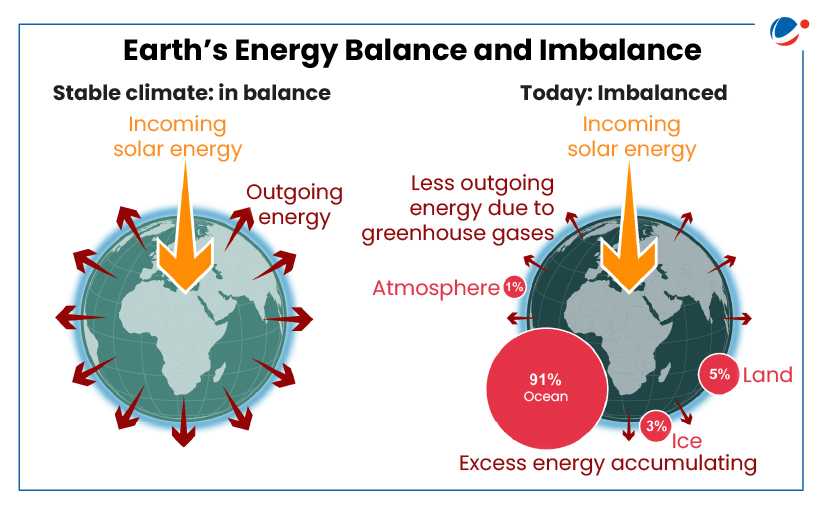
The findings were part of ‘State of the Global Climate 2025’ report, released by World Meteorological Organization (WMO) on World Meteorological Day (23 March, theme-Observing Today, Protecting Tomorrow).
- It included Earth’s energy imbalance (EEI) as one of the key climate indicators for the first.
About EEI
- It is the difference between amount of energy the Earth receives from the Sun (incoming solar radiation minus reflected solar radiation) and amount of energy the Earth radiates back into space (outgoing long-wave radiation). (see infographic)
- "Positive" EEI: Earth is gaining energy and heating "Negative" EEI: Earth is losing energy and cooling
- EEI measures rate of the heat accumulation by anthropogenic GHG emissions in climate system and provides a comprehensive picture of warming.
- Reasons for increase in EEI: Rising concentrations of GHG; reductions in aerosol emissions; increases in trace gases and water vapour (decreases outgoing long-wave radiation); decreased reflection by clouds and sea ice.
Other Key findings of the report
|
NHAI, in collaboration with National Remote Sensing Centre (NRSC) of ISRO, released the inaugural NH-Green Cover Index (GCI) for 2025–26.
Key highlights of the Index
- Coverage: ~30,000 km of National Highways across 24 states for the period between July and December 2024.
- It will track year-on-year green cover improvements.
- Satellite-based methodology: by detecting chlorophyll content via high-resolution satellite sensors of Resourcesat-2/2A and Cartosat-2S.
Article Sources
1 sourceNPC signed an Agreement with Ministry of Environment, Forest and Climate Change to act as Environment Audit Designated Agency (EADA) under Environment Audit Rules, 2025.
- It entrusts NPC with overall management of environmental audit framework, including development of eligibility criteria, registration of auditors, performance monitoring, etc.
About NPC
- Gensis: 1958 to undertake research in productivity.
- Ministry: Autonomous organization under Department for Promotion of Industry & Internal Trade, Ministry of Commerce and Industry.
- NPC is a constituent of Tokyo-based Asian Productivity Organisation (APO), an Inter-Governmental Body of which India is a founding member.
Article Sources
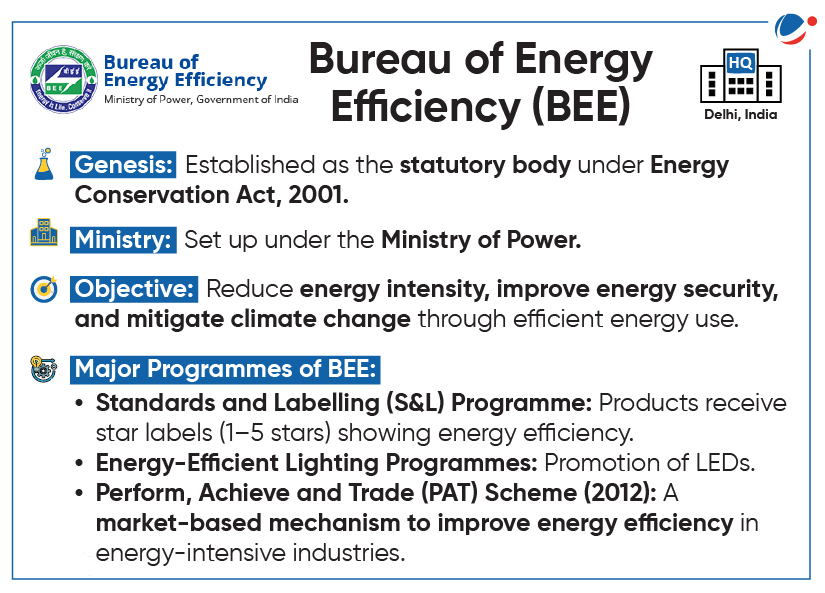
1 sourceBureau of Energy Efficiency (BEE) commemorates 25th Foundation Day.
Article Sources
1 sourceThe Supreme Court formally disposed of the landmark 1985 PIL filed by environmentalist MC Mehta.
- In MC Mehta case, Supreme Court recognized the principle of Absolute Liability andapplied Doctrine of Public Trust to natural resources.
- It also led to lead free petrol in India, coastal management plans in states, shifting of stone crushers out of Delhi etc.
Other Landmark Environmental Cases
- T.N. Godavarman Thirumulpad Case (1995) - Expanded the definition of forest land to include all areas recorded as forests in government records, regardless of ownership.
- Vellore Citizens Welfare Forum Case (1996) - Recognized the Precautionary Principle and the Polluter Pays Principle as essential features of Indian environmental law.
- S.P. Muthuraman Case (2025)- SC declared post-facto or retrospective environmental clearances illegal.
The Government of India is establishing a first-of-its-kind integrated plant based on Ocean Thermal Energy Conversion (OTEC) in Kavaratti Island, Lakshadweep.
About Ocean Thermal Energy Conversion (OTEC)
- Renewable energy technology that generates electricity using the temperature difference between warm surface water and cold deep ocean water.
- Condition: Requires about 20°C temperature difference; viable mainly in tropical oceans (30°N–30°S).
- Working: Cold deep-sea water and warm surface water run a heat engine to produce electricity.
- Use: Provides round-the-clock power and desalination for island regions.
Article Sources
1 sourceScientists have reported the discovery of “dark oxygen” production nearly 4,000 m deep in the Pacific Ocean.
About Dark Oxygen
- Oxygen produced in the deep ocean without sunlight, unlike photosynthesis-based oxygen production.
- Source: Linked to electrochemical reactions involving polymetallic nodules on the ocean floor.
- Significance: Challenges the belief that photosynthesis is the only major natural source of oxygen on Earth.
Trade between India and China will commence from June 1 through the Shipki La Pass in Himachal Pradesh.
- Trade through the pass was disrupted following the Doklam standoff and the COVID-19 pandemic.
- In 2025, India and China agreed to re-open border trade through the three designated trading points, namely Lipulekh Pass (Uttarakhand), Shipki-La Pass and Nathu-La Pass (Sikkim).
- Lipulekh Pass is located close to the tri-junction of India, China (Tibet) and Nepal.
About Shipki La Pass
- It connects India and Tibet (China).
- It was earlier known as Pema La, or Shared Pass.
- The Sutlej River enters India at Shipki La.
A Study shows Rising sea surface temperatures in coastal waters are leading to 50–64% rise humid heatwaves over land, aggravated by atmospheric Rossby wave trains.
- Humidity spikes wet bulb temperature which above 31.5°C is harmful as the body is no longer able to cool itself by sweating.
- Wet-bulb temperature is the lowest temperature to which air can be cooled by the evaporation of water.
About Rossby Waves
- They are huge, undulating movements of the atmosphere that stretch horizontally across the planet in a westward direction.
- They are triggered by Earth's rotation and ocean-land temperature differences.
- Stalled Rossby winds trap hot, humid air over the region, leading to heatwaves.



