


Why in the news?
Recently Ministry of Environment, Forest and Climate Change (MoEFCC) published a draft notification, under Environment (Protection) Act, 1986 (EPA, 1986) to amend EIA Notification of 2006, to reduce the delays at state level.
More on the News
- State bodies' (3-year tenure) delayed reconstitution also delays Environmental Clearance (EC) process impacting project timelines and investor confidence.
Key highlights of the draft
- Standing Authority on Environment Impact Assessment (SAEIA) for each state: To assume functions of State Environment Impact Assessment Authority (SEIAA) for maximum 1 year if it is non-functional or causes delay.
- Standing Committee on Environment Impact Appraisal (SCEIA) for each state: This committee will perform the duties of the State Expert Appraisal Committee (SEAC) for max 1year, if it is non-functional.
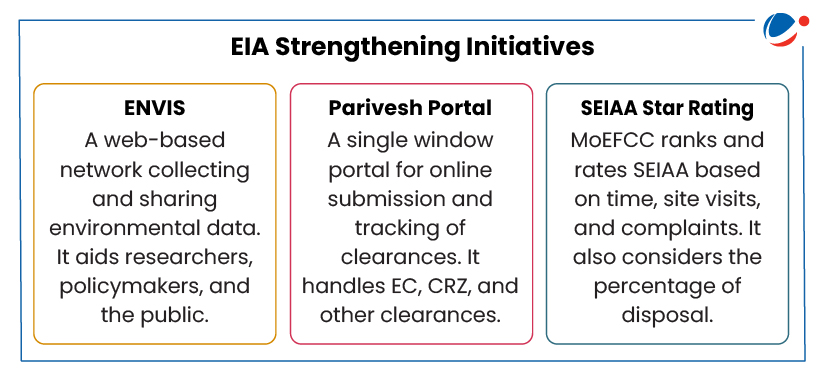
- If a SEAC fails to complete an appraisal within 120 days, the proposal moves automatically to the SCEIA via Parivesh portal
- Currently, in the absence of an SEIAA or SEAC, the central level Expert Appraisal Committee (EAC) manages the workload.
About Environmental Impact Assessment (EIA)
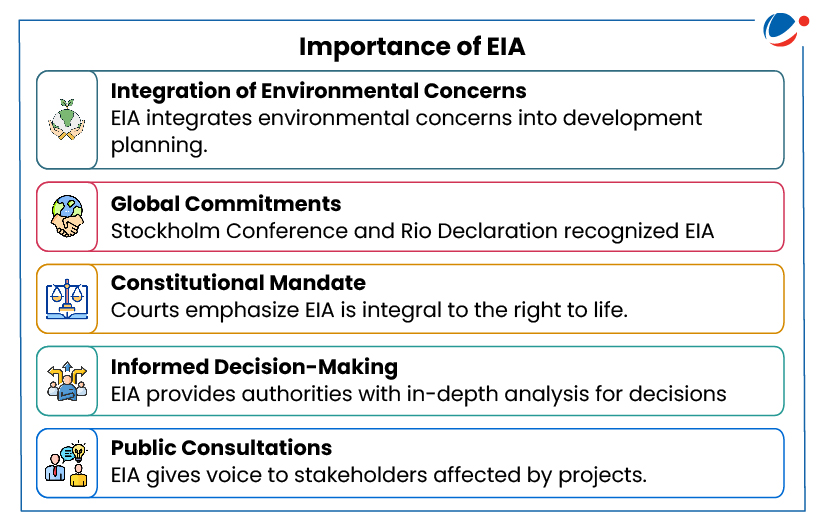
- Environment Impact Assessment (EIA) Notification, 2006, under Environment Protection Act 1986 is the principal regulatory framework governing ECs for development projects in India.
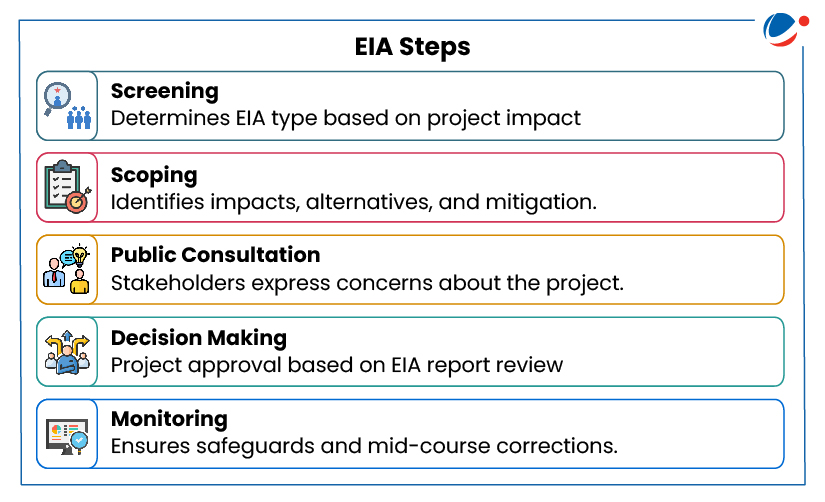
- It is a process to evaluate the potential environmental and social effects, both positive and negative, of a proposed project before it is approved
- Mandatory for projects above Rs 50 crores.
- Exemptions: Highway projects of strategic importance, 100 km from the borders, biomass-based Thermal power plants up to 15 MW using eco-friendly fuel mix, Solar and Wind Power projects, Hydro-electric projects less than 25 MW, etc.
- Process:
- Category 'A' projects: Require prior ECs from centre on the recommendations of a 15 membered body i.e.. Expert Appraisal Committee.
- Category 'B' projects require prior ECs from the SEIAA on the recommendations of a SEAC and are sub divided in Category B1 and B2 (B2- exempt from EIA).
- Key judgements
- Narmada Bachao Andolan v. UoI: Supreme Court upheld the role of EIA in balancing development and environmental protection.
- Vellore Citizens' Welfare Forum v. UoI, Supreme Court recognized 2 principle which are central to EIA i.e. polluter pays and precautionary principle.
- Centre for Environmental Law v UoI 2018: Court underscored the importance of stakeholder inputs via public consultations in the EIA process.
Challenges faced by EIA process in India
- Red tapism: Causing an average delay of 238 days in ECs hampering EoDB.
- It also leads to clearances without adequate scrutiny. E.g. According to Centre for Science and Environment > 90% of projects submitted for clearance are approved.
- Gap between paper promises and ground realities: Eg. Vizhinjam Port Project (Kerala) despite EIA clearance, project faced allegations of coastal erosion and displacement.
- Poor Quality of Reports: As flagged by court in Sterlite Industries (India) Ltd. V. UoI due to use of unreliable data, Lack of trained EIA professionals. E.g. Sardar sarovar project case.
- Weak Public Consultation: Lack of translation of technical reports in local languages, Insufficient information provided to local people e.g. Dhabol Power plant case
- Conflict of Interest: EIA reports in India are frequently prepared by consultants, hired by project proponents.
- Prioritization of economic development (EoDB) over ecological sustainability e.g. Draft EIA notification 2020
- Draft 2020 reduces notice period for public hearings from 30 to 20 days, add projects from oil and gas sector etc. to B2 category, excludes public reporting of violations etc.
- Retrospective Clearance for some activities: allows pollute first and forgiveness later as consequences are often irreversible (dilutes precautionary Approach)
- Transboundary assessment: This has not been adequately addressed in EIA framework E.g. India has not ratified Convention on EIA in a Transboundary Context (Espoo Convention 1991).
- Others: Dilution via exemptions, preferring procedural continuity over scientific scrutiny, political interference, weak post-clearance monitoring etc.
Way ahead
- Strengthening Expert Bodies: Prioritise timely reconstitution of SEIAA/SEAC with transparent appointment of expert scientists instead of relying on bureaucratic fallback mechanisms.
- Learn from best practices: UK's autonomous monitoring body to monitor post-clearance compliance and integration of EIA in land use planning
- Inclusive public participation: Via longer notice, regional-language reports, and real consideration of community concerns in decisions.
- Enacting a Standalone EIA Law: to provide greater legal stability and prevent frequent administrative dilutions eg. China's Environmental Impact Assessment Law of 2002.
- Integrating Strategic Impact Assessment: While EIA focuses on ecological effects (biodiversity, air, water), Strategic Impact Assessment focuses on human impacts (livelihoods, culture, health) which is more holistic in nature.
- Others: Integration of tech like Remote sensing, AI etc., landscape-level approach (accounts for effects of multiple projects within a region, Independent 3d-party verification etc.
Conclusion
While the MoEFCC's recent draft notification attempts to resolve the immediate bottlenecks of EIA, genuine reform of India's Environmental Impact Assessment (EIA) framework demands a more holistic approach. As both a constitutional mandate and a global commitment, the EIA is fundamentally designed to ensure informed decision-making that balances development with ecological preservation.


