


Why in the News?
The WTO Agreement on Fisheries Subsidies has officially entered into force after two-thirds of WTO members submitted their instruments of acceptance.
About WTO Agreement on Fisheries Subsidies
- Overview: It is the first WTO agreement to explicitly focus on the environment and the first broad, binding, multilateral agreement on ocean sustainability.
- Adoption: It was adopted at the 12th WTO Ministerial Conference (MC12), Geneva, 2022 and entered into force on September 15, 2025.
- Aligned with SDG 14: The agreement seeks to protect marine ecosystems through the elimination of harmful fisheries subsidies.
- SDG 14.6 aims to eliminate harmful fisheries subsidies that cause overfishing, overcapacity, or support Illegal, Unreported, and Unregulated (IUU) fishing.
- India: India has not yet ratified the Agreement.
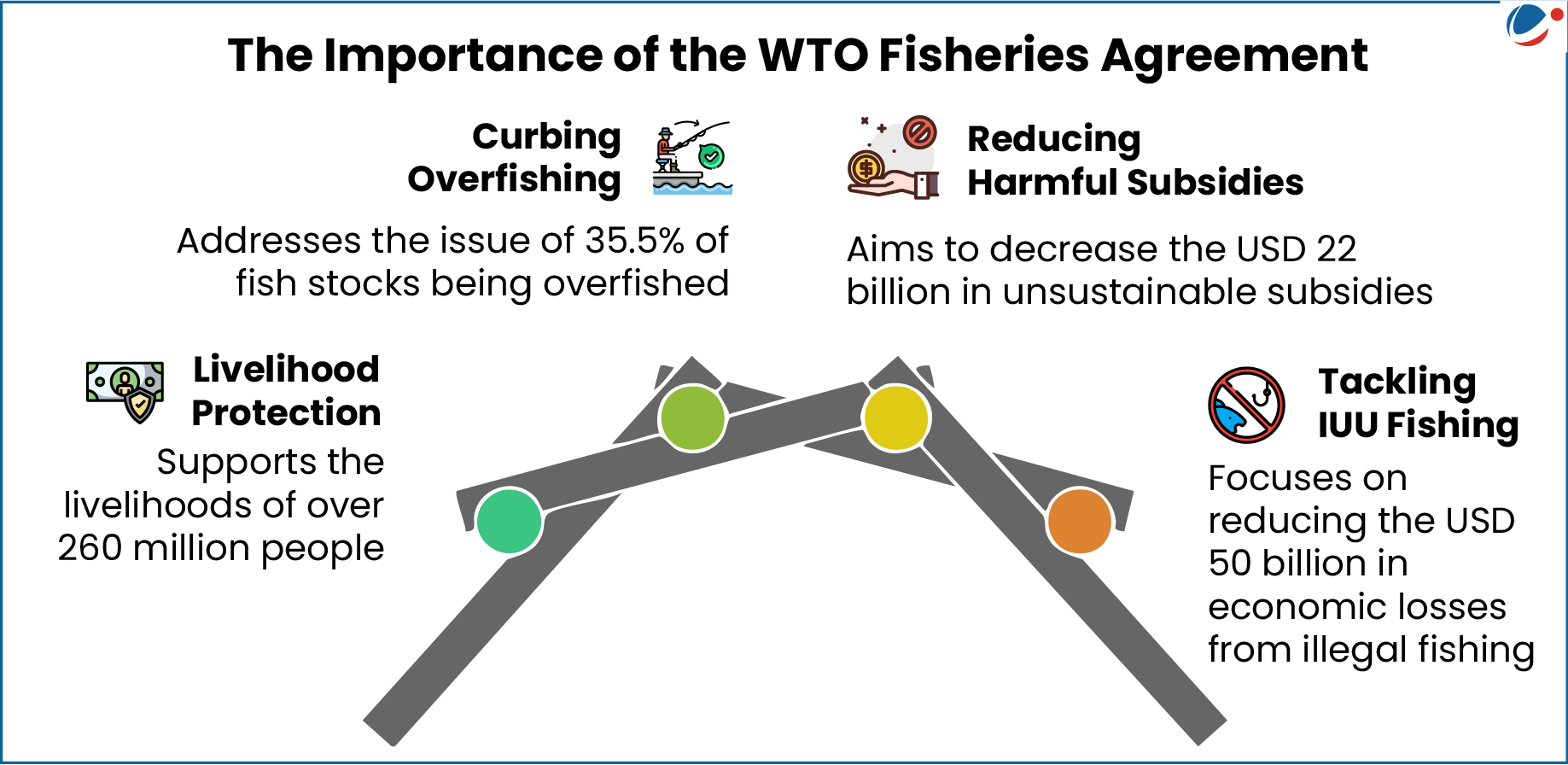
Key Provisions of the Agreement
- Prohibition of Harmful Subsidies: The Agreement prohibits subsidies that contribute to Illegal, Unreported, and Unregulated (IUU) fishing, as well as those linked to overfished stocks and unregulated fishing activities in the high seas.
- The top 5 subsidizers i.e., China, EU, U.S., South Korea, and Japan, account for 58% of the global fisheries subsidies.
- Special and Differential Treatment (S&DT): Recognizing the developmental needs of poorer nations, developing and Least Developed Countries (LDCs) are granted a two-year transition period from the date of entry into force of the Agreement.
- WTO Fish Fund: The Agreement creates a voluntary funding mechanism to support developing and least-developed countries (LDCs) with technical assistance and capacity building for its implementation.
- It is fully operational.
- Transparency obligations: Members are required to notify the WTO about their fisheries subsidies, fish stock status, and management measures.
- High Seas Fishing: The Agreement also prohibits providing subsidies for fishing on high seas, which are outside the jurisdiction of coastal countries and Regional Fisheries Management Organizations/ Arrangements (RFMO/As).
- Implementation: A Committee on Fisheries Subsidies will oversee the Agreement's implementation, ensure transparency, and facilitate regular dialogue among members on their fishing practices and subsidy policies.
Why India has not ratified the Agreement?
|
Implementation Issues
- Capacity Constraints: Many developing countries lack the technical and institutional capacity to monitor fishing activities and ensure compliance with the Agreement.
- Data Gaps: Incomplete or unreliable data on fish stocks and subsidies may hinder accurate reporting and transparency.
- Enforcement Challenges: Effective monitoring of high seas and distant-water fleets remains difficult due to jurisdictional limitations and lack of surveillance infrastructure.
- Financial Dependence: Small-scale fishers in developing countries rely on limited subsidies for livelihood and food security, making abrupt withdrawal challenging.
- Unequal Obligations: Concerns persist that the Agreement may disproportionately affect developing nations, while major subsidizing nations continue with capacity-enhancing support under different categories.
Way Forward
- Strengthen Capacity Building: Enhance technical and financial support through mechanisms like the WTO Fish Fund to help developing countries comply effectively.
- Improve Data and Monitoring Systems: Establish robust national databases and use satellite-based tracking and digital tools for better reporting and enforcement.
- Promote Equity: Ensure that the principle of Common but Differentiated Responsibilities (CBDR) guides to protect the interests of small-scale fishers.
- Global Cooperation: Foster coordination among RFMOs and promote information sharing to combat IUU fishing collectively.
Conclusion
The WTO Agreement on Fisheries Subsidies aims to protect oceans and fish stocks by curbing harmful subsidies and promoting transparency in fisheries management. This is expected to lead to the recovery of fish stocks, better monitoring of fishing, the establishment of sustainable fishing measures, and the protection of food security and income for people dependent on fisheries globally. It is a common effort to better protect our oceans, our fisheries and our shared future.